Friday, February 29, 2008

Once Upon a School: Help Dave Eggers' TED Wish Come True

"Teachers, I believe, are the most responsible and important members of society because their professional efforts affect the fate of the earth."--Helen Caldicott
In 2002, Dave Eggers, author of A Heartbreaking Work of Staggering Genius and What is the What, co-founded a writing and tutoring center, 826 Valencia in San Francisco. Over the next six years additional 826 centers opened in New York, Chicago, Los Angeles, Seattle, Michigan and Boston under the umbrella of 826 National.

This week Eggers is one of three recipients of the 2008 TED Prize during the TED Conference in Monterey, CA. Each winner received a prize of $100,000 and was granted, "a wish to change the world."

Yesterday the TEDBlog posted Eggers' wish:
"He asks the conference's attendees -- and anyone else who's in a position to help -- to 'find a way to directly engage with a public school in your area' and then share the story of their involvement on the OnceUponASchool website, hoping in their inspirational effect to start a virtuous circle, 'so within a year we have 1000 examples of transformative partnerships.'"
Ethan Zuckerman of My heart's in Accra is live-blogging (incredibly well!) from the TED Conference. In his post, Dave Eggers' Wants You to Go to School, he captures Dave's story of how the idea for 826 Valencia started (emphasis added):
"Wringing his hands, he talks about writing his first novel, living in Brooklyn. He wrote from midnight to 5am every day, and he and his writer friends 'had a lot of scheduling flexibility.' Many of his friends were teachers, and they talked a great deal about their struggles. Teachers were struggling to keep students reading and writing at grade level.

Many of these kids don’t speak English in the home. Some have learning disabilities. They desperately need personal attention, but teachers might see 150 to 200 students a day - how do you give each student one on one attention? Eggers saw a supply and demand - kids in need of attention, and writers with flexibility and a love of the written word."

You can join the Once Upon a School initiative by:
1. Finding an idea. Having trouble thinking of something? Peruse their of list ideas.
2. Being inspired. Read through stories by people who have already started a project.
3. Telling your story. Inspire others with your project's story.
You can also support the Once Upon a School project directly with their list of needs.

Follow more live-blogging coverage of the rest of the TED Conference on Bruno Giussani's blog, LunchoverIP and Ethan Zuckerman's My Heart's in Accra, and through posts and Twitter "tweets" from this list of who is blogging from the TED Conference.

Image Credit: Public Art by Greg Dunham.


Wednesday, February 27, 2008

Women Musicians Shine a Light on New Orleans

March 2-6, four women arts activists (Cris Williamson, Vicki Randle, Alix Olson and Pamela Means) will travel to New Orleans to collaborate with four local women musicians (Asia Rainey, GaBrilla Ballard, Sunni Patterson, and Charmaine Neville). The trip is being organized by the Artistic Director of Women Center Stage, Olivia Greer, who I interviewed last year, as part of Culture Project's EMANCIPATE program. During the trip, the eight women will travel together throughout the area to meet with activists and community-based organizations.

On April 27 the eight musicians will meet again in New York City to perform new songs inspired by their trip as part of the Women Center Stage Festival. In June, their songs will be recorded, and the CD sales will benefit a community organization in New Orleans.

Jacqueline Lee, a Women's eNews correspondent went to the first EMANCIPATE event this summer during the Women Center Stage Festival. In her post, Center Stage Struck, she wrote about the experience:
"I felt more confident about myself and my own thoughts just being in a roomful of women who could speak their minds so strongly and have it be OK, and to hear how they think and what they have to say."
Melissa Silverstein also reported from the Festival for the Huffington Post in her piece, Women Center Stage -- Women Artists and Activists for Social Change:
"Emancipate brings together activist women songwriters using art to raise consciousness in their communities. Singer Taini Asili, who is committed to the movement to free Mumia Abu Jamal, used her set to sing about breaking out of our own mental prisons, and Alix Olsen a self defined radical lesbian feminist railed against the political establishment."
You can follow news from the eight women's travels on the EMANCIPATE web site and leave a comment in their Guestbook.

Photo Credit: Cris Williamson and Vicki Randle by Shoshana Rothaizer.


Friday, February 22, 2008

Interviews with 30 Social Changemakers: Big Vision Podcast 2nd Anniversary

February 18, 2008 was the 2nd anniversary of the Big Vision Podcast!

A big thanks to everyone who listens to the program and reads the interview transcripts here on Have Fun * Do Good.

Over the past two years I have had the privilege of interviewing 30 "Big Visionaries." Their stories are the fuel that keeps me going. I hope they are inspiring for you as well.

I've listed all of the interviews below with links to the podcast and the transcript. Please note that since the interviews take place over two years, some people's work has changed and they may have new job titles, or may be working somewhere else now.

Alli Chagi-Starr, Co-Founder, Art in Action / Art & Media Director, Ella Baker Center for Human Rights’ Reclaim the Future Program (Alli is now the Event Chair of The Dream Reborn, Green For All)
Listen
Read

Eric Fenster & Ari Derfel, Co-owners, Back to Earth
Listen
Read


Brahm Ahmadi, Executive Director, People's Grocery
Listen
Read


Mei-ying Ho, Co-Director of SOUL (School of Unity and Liberation)
Listen
Read

Abby Jaramillo (formerly Rosenheck), Executive Director of Urban Sprouts
Listen
Read


Ilyse Hogue when she was the Global Finance Campaign Director for Rainforest Action Network. Now she is the Campaign Director for MoveOn.org
Listen
Read


Steve Williams, Co-founder and Executive Director of POWER (People Organized to Win Employment Rights)
Listen
Read

Anna Lappé, co-author of Grub: Ideas for an Urban Organic Kitchen and co-founder of the Small Planet Fund.
Listen
Read


Nola Brantley, Parenting and Youth Enrichment Director, and the Coordinator of the Sexually Abused and Commercially Exploited Youth Program at the George P. Scotlan Youth Program in West Oakland.
Listen
Read

Lisa Russ, Associate Director of the Movement Strategy Center
Listen
Read


Jonah Sachs, Principal of Free Range Studios
Listen
Read


Jessica Jackley Flannery, Co-Founder and Board Member of Kiva.org
Listen
Read


Ingrid Severson, Lead Organizer of the Rooftop Resources Project, a project of Bay Localize
Listen
Read


Melinda Kramer, Founder & Director, Women’s Earth Alliance (formerly Women's Global Green Action Network)
Listen
Read

Kevin Danaher, Co-founder of Global Exchange and Executive Director of the Global Citizen Center
Listen
Read

Reem Rahim, Co-founder and Chief Marketing Officer of Numi Tea
Listen
Read


Jodie van Horn Freedom, Campaigner for Rainforest Action Network's Freedom From Oil campaign, and the Coordinator for Plug-In Bay Area
Listen
Read

Priya Haji, CEO and Co-founder of World of Good.
Listen
Read


Paul Rice, founding President & CEO of TransFair USA
Listen
Read


Van Jones, co-founder and President of the Ella Baker Center (Van is now the President and Founder of Green for All)
Listen
Read


Chris Messina of Citizen Agency and Ivan Storck of SustainableMarketing.com and SustainableWebsites.com talk about how to start a green coworking space based on their experience with Citizen Space in San Francisco, CA.
Listen / Read


Elizabeth Pomada Co-Founder of the Writing for Change Conference
Listen
Read


Marsha Wallace Founder of Dining for Women
Listen
Read


Shalini Kantayya, Filmmaker, A Drop of Life.
Listen
Read


Paola Gianturco, photojournalist, Women Who Light the Dark
Listen
Read


Andre Carothers, Co-Founder and Executive Director, Rockwood Leadership Program
Listen
Read


Christina Arnold, Founder of Prevent Human Trafficking
Listen
Read


Cristi Hegranes, Executive Director and Founder, Press Institute for Women
Listen
Read


Thanks for listening and reading! If you have suggestions for people to interview for the Big Vision Podcast, email me at britt@brittbravo.com


Thursday, February 21, 2008

NetSquared Mashup Challenge: How Do You Combine Data for Social Change?

As some of you know, part of my work is being the Community Builder for NetSquared, a project of Tech Soup that facilitates the adoption of social web tools by nonprofits and NGOs.

We're hosting a contest called the NetSquared Mashup Challenge that I wanted to let you know about, and am hoping that you'll pass on to social changemakers and web innovators in your community. You don't need to have tech expertise to submit a project to the Challenge, just an idea for a change you want to make that could be facilitated by a mashup.

Wikipedia defines a mashup as, "a web application that combines data from more than one source into a single integrated tool." So, for example, MAPLight.org brings together campaign contribution data and legislators' voting records to raise awareness about the connection between money and politics.

Another example is ilovemountains' new mashup for their "What's My Connection?" campaign. The What's My Connection tool combines 6 types of data so that when you punch in your zip code , you can see how you are paying for mountaintop removal. When I enter my zip code, I can see that my electricity provider, Pacific Gas Electric Co, buys coal from companies engaged in mountaintop removal, and the connection is represented visually on Google Maps and Google Earth.

If you have an idea for a way to combine data that could raise awareness around an issue, submit it to the NetSquared Mashup Challenge by March 14, 2008 5 PM PST for a chance to win cash prizes.

The top 20 mashups will be selected by the NetSquared community and the winners will be invited to attend this year’s NetSquared Conference (N2Y3) in San Jose, CA May 27-28, 2008. Each of the top 20 mashups will get an allowance for travel (including airfare to and from the Conference, along with a hotel room for two nights).

At the Conference, project teams will have an opportunity to display and discuss their mashups, and attendees will vote to select the top three. All twenty projects at the Conference will receive a share of $100,000 in prize money. The share will be determined by voting at the Conference.

You may know the winner of the Challenge, but without your help they'll never know to enter the contest!

Here are a few tools to help you spread the word on your blog, community list servs, or just by emailing your friends.

NetSquared badges to put on your blog, web site or email signature.
• A YouTube video about the Challenge.
• An informational postcard to pass out at local events.

If you want the latest news about the NetSquared Mashup Challenge, subscribe to the NetSquared Newsletter (sign up on the home page), NetSquared Blog and NetSquared Twitter feed, and join the NetSquared Facebook group.

Thanks for helping to spread the word, and add a comment to this post if you enter!


Friday, February 15, 2008

Empowering Women Citizen Journalists: An Interview with Cristi Hegranes

"Now, 18 months later, all of Juana's children are in school. She went from being somebody's servant to somebody who when she walks down the street of her community, people stop her and shake her hand and thank her for the stories that she is telling, or ask, 'When are you going to interview me? I have a story that you have to hear.'"

The Press Institute for Women in the Developing World is an international nonprofit organization and citizen journalism initiative. Last month I interviewed Cristi Hegranes, its Founder and President. In January, Cristi was named one of the 21 Leaders of the 21st Century for 2008 by Women's eNews. She was also awarded their annual Ida B. Wells prize for Bravery in Journalism. You can listen to the interview on the Big Vision Podcast, or read an edited transcript below.

Cristi Hegranes: My name is Cristi Hegranes and I am the President and Founder of The Press Institute for Women in the Developing World which is an international nonprofit organization that was founded in order to train women in developing countries to become investigative reporters to report their own news.

The goals of the organization are three-fold. We use journalism because it is a very empowering profession, enabling people to become the "question askers" in their societies. It is a really exciting and empowering position, especially for women in developing countries. Our primary goal is to provide that empowering employment.

The secondary goal is to provide better free, or fair information to people in these countries. So often, government control, or just lack of access to information and media, prevents people from really being able to be educated and informed about serious issues that are going on around them. We make a huge effort to disseminate our news locally via radio partnerships, and other satellite partnerships, so that the people in the communities we serve are benefiting from our news first.

The third goal would be, on an international level, to take this news, that is really created from the inside out, as opposed to the traditional model of foreign correspondence, which is an outsider coming in, out into the world. We sell our content to mainstream and other media organizations all over the world.

Britt Bravo: Why is it important to have women citizen journalists in developing countries at this time? What is it that motivated you to create this program now?

CH: You know it is funny; it actually didn't start out as a women-centered initiative, but the more research I did about creating global training sites and free media enterprises in these developing countries, training women just makes the most sense. When women have access to specific skills, training, and education, all of a sudden their survival and livelihood statistics shoot way up, not only their own, but entire communities.

For example, when women have this kind of specific skill-set training, they are more likely to have less children, to keep the children they do have in school, to be able to provide access to medical care, and things like that. Training women became an obvious imperative for us when we are talking about who are we going to train and why.

I think there is an extra added level of really pushing the envelope of gender equality. In some of the places where we work, women are very often not in professional roles whatsoever, much less the media. We are pushing an envelope there.

There is also a really practical level of source access. For some of the topics that we train our reporters to cover, like reproductive rights and political oppression, women have better access to the kind of sources that we want than men, outsiders, or other traditional foreign correspondents would.

BB: Can you talk a little bit about the program, how long it is, what the women learn, and what some of the challenges are for them to make the training happen within their every day life? Who are the women who are showing up? Are they women with families, are they young, are they old, and how are they fitting the training into what I am sure is a very busy, and already challenging life?

CH: Right, exactly. Well, they are all of the above. Our age ranges in all of our global training sites range from 19 to 56. We are training women at all levels in their life. Many of our trainees and journalists in Nepal do have children. They come from all different casts, all different religions, and from indigenous backgrounds in Mexico.

We really try and get women from all walks of life to be able to participate in our program, the goal being to provide as many unique voices and opportunities as possible.

BB: What is the path that brought you to this work personally?

CH: I was a foreign correspondent in Nepal from 2003 to 2004 and had a really amazing experience in Nepal. I learned to speak the language fluently, and was there at a really intense time in terms of the civil war, and a lot of the political uprisings that were going on.

I had an amazing opportunity to cover the civil war, but also to cover a lot of the human rights issues that were emerging as a result of the war. But at the same time, I realized a lot of the limitations that the mainstream model of foreign correspondence often provides.

I came back to the States after working in Nepal, and I took a job as a feature writer in San Francisco. It was what I thought would be my dream job. I was actually making money as a feature writer in a great city, but it became really obvious to me that my definition of journalism, and the definition of journalism that I was being asked to practice, as a member of mainstream media, were not the same.

I kept going back to this one experience that I had in Nepal, where I was working in a village that was literally inhabited only by women, because so many men in Nepal were either at war or they go abroad for work. A lot of Nepali men are working in the Middle East, or they go abroad to India to work, just because there isn't really a job market at all in Nepal. It is getting better now, but especially in the heat of the civil war, there wasn't one.

I was in this village that was inhabited pretty much only by women, a couple of old men, and some little kids running around. I remember being so frustrated with my inability to fully tell the story that I knew was going on, but it was a matter of an absence of historical, political, and social context that I just didn't have. And no matter how long I spent in-country, I would never have.

I remember handing a notebook and some pens to a women, Pratima was her name, she was the matriarch of the village. I said, "You write it. You tell your story." It was written in very scribbled Nepali, her literacy skills were incredibly rudimentary, but what she ended up writing was a piece of journalism.

When I was back in San Francisco, in my cushy feature writer job, I just couldn't get that out of my head. I had the feeling that there was something else that I could be doing with my passion for journalism and my knowledge of international reporting.

BB: So right now you work in Nepal and in Mexico?

CH: Yes.

BB: And do you have plans to expand to other counties, and if so, where?

CH: Yes, we do. We have a grand plan; my dad calls it the grand plan for global domination [laughs]. Our office in Rwanda was supposed to be our next office opening anytime now, but because of the war in the Congo, visas and business licenses and things like that have been put on hold.

Our office in Kigali is sort of in a state of question right now. Hopefully sometime in 2008 we will be able to establish that office. Hopefully, the situation in the Congo resolves itself and doesn't cross the border into Rwanda, as it did in the '90s. We are hopeful that we will be in Rwanda by the end of the year.

We are also in discussions about the whole process of getting international nonprofit licenses in different countries. It is different in every place and oftentimes very laborious, but we are working on a potential program with The Open Society Institute in Myanmar.

We are also in discussions in Peru, in Burkina Faso, and in Botswana as well. I am working with a foundation right now trying to plan out our Africa initiative for the remainder of the year. It would be great to have as many as two to five new offices in 2008 as our goal.

The path is laid out very clearly now. We know what we need, all the materials are prepared, we know how to recruit, we know how to train. The first two offices were great trials and so now, we are hoping to be able to expand more quickly, which is of course fundraising dependent, but that's increasing as well, so that is going well too.

BB: How will you know when you have succeeded? If you have a success story, you could share that too.

CH: I think I am conscious of the fact that we are all succeeding constantly, because the impact has been so profound. When we do recruitments in these countries, and we get the word out, what our program does and that we are training. . . .There are only two requirements to join our program: basic literacy skills and the ability to sort of talk about how good journalism would make a difference in their communities and their lives.

That is pretty much what we go on. We go on our gut instinct from people's answer to that one question, and then there is literacy testing involved as well. When we recruit in these areas, our first recruitment session in Mexico, we had about 47 women show up for five spots. About eight months later in Katmandu, we had hundreds of women show up for five spots.

For me, that was the first time where I was like, "Oh, maybe I didn't throw my entire career away, and I am actually doing something worthwhile." It's a really powerful thing to come up with an idea and have people, so different from you, believe in that same idea.

With this award from Women's eNews, the Bravery in Journalism Award, I told Rita Henley Jensen, who is the founder of Women's eNews, I will accept it, but know that I don't accept it, that I accept it on behalf of the women who work for me. They are the ones who act in bravery constantly; they are the ones who take risks and make bold statements constantly.

My definition of success has been watching women grow. I am impressed constantly at the way that these women have been able to use journalism to lift themselves out of really depressed economic or violent situations. We have one woman in particular who is very close to my heart, because of what she has been able to do with this opportunity.

Her name is Juana and she is one of our journalists in Chiapas. When she started our program, she had the least education of anybody in our group; never been to school. She had been a domestic servant since she was eight years old, and she was 28 when she joined our program.

She had four children. They were 14, eight and three, and she was in an incredibly economically depressed situation. She had me over to her home for dinner, and it was four very ramshackle walls, a tarp for a ceiling, dirt floors. They all slept in one bed, and there was an open fire in the middle of the room where they cooked their food, which is certainly not an uncommon situation in rural indigenous Mexico.

Now, 18 months later, all of Juana's children are in school. She went from being somebody's servant to somebody who when she walks down the street of her community, people stop her and shake her hand and thank her for the stories that she is telling, or ask, 'When are you going to interview me? I have a story that you have to hear.' Sometimes really serious tips come her way too.

She just did a piece recently about land use fraud that she got from a tip, because she has such a phenomenal reputation for being somebody who is providing accurate, fair news, and writing about stuff that nobody else in Chiapas is writing about. Just a couple of months ago, I guess three months ago, when I was back down there, I went to her home again. She had bought a roof and her youngest daughter, Lucia, was so excited to show me that they had a sink, and Patty, the oldest, had her own bed.

She has been able to use this opportunity to uplift herself professionally. The way she walks, the way she dresses, the way she speaks, it is all very different now. Eighteen months ago, she was an uneducated woman who was somebody else's servant. Now she is the commander of her own life and she has been able to uplift herself and children as well, who are in school and are just angels.

That to me is the definition of success. She is probably the most shining example of what The Press Institute is capable of both journalistically and personally.

BB: With your recent awards, you are probably getting more interview requests. What is the question you wish people would ask you? What is the thing you would like to talk about?

CH: How much money can I donate? [laughs]

I think the best part of The Press Institute, and what I wish people would see, is that it is an example of the kind of media that is possible. One of our board members, who lives in Nepal, always does a little spin on Gandhi's famous quote, "Be the change you wish to see in the world." She says, "Create the media you wish to see in the world."

I think The Press Institute is a lot of things, but I think it is primarily an example of how you can use development, technology and the core principles of journalism to really create change internationally. I think that it is so easy to be placated by the kind of news that is common now, but it doesn't have to be that way.

If The Press Institute can spur any kind of conversation, I would hope that it would spur conversations about creating new ways of reporting, and that new ways of creating access to information for people everywhere is really possible.

BB: How can listeners help? How can they get involved if they are interested in your work and in supporting you?

CH: Our headquarters office here in Oakland is staffed entirely by volunteers, and I always like people to know that of all of the foundation dollars, and donations and grant money that comes in, I divert 94% of it to our in-country operations. I don't currently take a salary from The Press Institute, and this office is entirely staffed by volunteers.

Very little of the money that we get is used in the U.S. It is great when people know that their money is going directly to the journalists, directly funding somebody's life and somebody's well being.

They can volunteer locally, or from anywhere. We have a lot of people who are not local here in the Bay Area that host dine-arounds, and little fundraisers for us, things like that.

Just reading the news that our journalists produce and forwarding it along. We do sell our content to media organizations all over the U.S., so oftentimes some of our big fans of our content have contacted their local newspaper and said, "Why aren't you picking this up? This is the kind of stuff we want to be reading." That is also very valuable for us, for more media outlets to be aware of our content, and what we are producing.

There are many ways that people can be involved, and I am incredibly grateful for it. We probably have four or five dozen volunteers around the United States, and we have more than 500 individual donors all around the world, which to me is such a powerful statement.

We have $2 donors out of Zimbabwe and $20,000 donors out of San Francisco. We're making the rounds around the world, and it is really nice to see people read our content and really get on board with our message.

BB: Is there anything else that you want people to know about The Press Institute that you didn't get to talk about, or mention?

CH: I think one thing that is so important to me is the principles of journalism. Our reporters are trained with a really strong push and focus on objectivity, balance and fairness. It was my goal initially to create a 100% independent newswire, and we are sticking to that. We don't take government or corporate dollars for any of our funding through grants, or anything else.

We really pride ourselves on our ethics, our objectivity, and that goes from the journalism, to the fundraising, to every aspect of the organization. It is important to me that people know that we are really a 100% independent newswire, and that our journalists are trained to be very objective. We study the concepts of objectivity and balance and fairness, and what it means in each unique situation, with each unique story that they are telling. It is huge focus of the training.


Wednesday, February 13, 2008

Got the Winter Blues? Giving May Cheer You Up

"I have found that among its other benefits, giving liberates the soul of the giver."--Maya Angelou

In December 2007, the New York Sun article, Why Giving Makes You Happy reported that:

"According to the Social Capital Community Benchmark Survey, a survey of 30,000 American households, people who gave money to charity in 2000 were 43% more likely than non-givers to say they were 'very happy' about their lives.

Similarly, volunteers were 42% more likely to be very happy than non-volunteers. It didn't matter whether gifts of money and time went to churches or symphony orchestras — givers to all types of religious and secular causes were far happier than non-givers."

Now maybe you're thinking, "I bet they were happier because they had extra money and time to give--which I don't," but a 2006 study found that the good feelings we get from giving are biological. According to the Washington Post article, If It Feels Good to Be Good, It Might Only Be Natural, another study found that when,
"volunteers placed the interests of others before their own, the generosity activated a primitive part of the brain that usually lights up in response to food or sex. Altruism, the experiment suggested, was not a superior moral faculty that suppresses basic selfish urges but rather was basic to the brain, hard-wired and pleasurable."
According to the Corporation for National and Community Service, volunteering also has health benefits. Here are a few factoids from their site:

"Volunteer work improves the well being of individual volunteers because it enhances social support networks. People with strong social support networks have lower premature death rates, less heart disease, and fewer health risk factors. (Fact Sheet: Volunteering as a Vehicle for Social Support and Life Satisfaction, Public Health Agency of Canada)

Volunteering can improve self-esteem, reduce heart rates and blood pressure, increase endorphin production, enhance immune systems, buffer the impact of stress, and combat social isolation. (Research Summary: Graff, L. (1991). Volunteer for the Health of It, Etobicoke, Ontario: Volunteer Ontario.)

Volunteering lowers the risk of physical ill health because it boosts the social psychological factors that healthy people have. (The Effects of Volunteering on the Volunteer, John Wilson and Marc Musik, 62 Law & Contemp. Probs., Autumn 1999)"

There are so many resources available to help you give time, money, skills and stuff, it could probably fill a phone book. Here are just a handful of resources to get you started:

Time: VolunteerMatch is a great place to start looking for a volunteer opportunity.

Money: If you want to search by issue for a cause to support, Network for Good and Global Giving are two places to start. I'm a big fan of Kiva too.

Skills: SCORE (Counselors to America's Small Business) facilitates volunteer mentors' giving advice to aspiring entrepreneurs.

Things: Find a Goodwill or public library near you to donate clothes and books.

Giving doesn't have to be through an organization or institution. Small acts of kindness count too.

The Random Acts of Kindness Foundation has named February 11-17, 2008 Random Acts of Kindness Week. They have e-cards you can send, guides and lesson plans to download, and graphics you can print as posters, stickers, t-shirts, etc.

Abigail Beal of Step by Step Fundraising posted a few ideas for how to participate:
  • Hold a door open for someone.
  • Write a thank you note to someone who helped you or made a difference in your life.
  • Give blood.
  • Call an old friend.
  • Buy the person behind you in line’s coffee, lunch or toll
  • Tell your co-workers you appreciate them and give examples why.
  • Compliment someone.
  • Volunteer to read to students or at a nursing home.
  • Smile at people on the street.
Chelley from Live Fully, Laugh Often, Love Deeply is participating and posted the "Kindness: Pass It On" poster (above) from the Random Acts of Kindness Foundation on her blog.

Dawn Sarli of Servin' It Up is celebrating the week as part of the Altruism and the Good Life course she is co-teaching at Green Mountain College in VT.

A Candy-Colored Life . .. Is Sweet
has challenged herself this week to:

"[B]e a little kinder every day. To myself, to my friends, to my pets, to my family, to my planet, to everyone. To be more engaged in what’s going on around me. To remember to look up and smile when I pass a stranger on the street. To breathe, count to ten and let it go when my neighbor parks his dilapidated jalopy too close to my driveway for the ten billionth time. To be extra careful to say please and thank you and you’re welcome. To remember that a little bit of kindness goes a long way."
How will you celebrate?


Friday, February 08, 2008

Pie Ranch, Sugar High Friday and A Pie That Evokes Your Dreams

One of the best parts of the movie Waitress is the names that Jenna (played by Keri Russell) gives the pies she makes like, "Falling-in-Love Chocolate Mousse Pie."

Inspired by the film, Rachel of Vampituity is asking people to create a Pie That Evokes Your Dreams for February's food blogging event, Sugar High Friday, and to help support the dreams of the nonprofit, Pie Ranch, in the process.

Pie Ranch is a Bay Area nonprofit that teaches urban youth about food and farming:
"We have planted wheat for pie crusts and berries for filling, and are raising bees for honey, goats for milk and chickens for eggs on a 14-acre parcel above the historic Steele Ranch at Green Oaks Creek. In 2005, we began our youth education programs, inviting school groups out to experience a working farm. Through hands-on collaboration, teenagers discover new competencies that benefit them as individuals and in community."
In addition to the pie-shaped ranch, they also have a cafe in San Francisco's Mission District, Mission Pie, where they sell pies and teach youth job skills.

Sugar High Fridays were created by The Domestic Goddess in 2004. The last week of every month, food bloggers send in dessert recipes based on a theme. Check out the yummy collection of recipes from when the theme was, The Proof is In the Pudding.

To participate in The Pies That Evoke Your Dreams Project during this month's Sugar High Friday, create a pie that embodies your dreams, and post about it on your blog.

All participants are asked to include the following text in their post:
"Sound delicious? Make a contribution to a nonprofit helping to transform the world of food through pie: Pie Ranch. Please specify 'Pie Ranch/Green Oaks Fund' in the Designation field of the online donation form. Pie Ranch is fiscally sponsored by the Rudolph Steiner Foundation."
Email a link to your post, a thumbnail image, your name, the country where you live, and one sentence about your pie to Vampituity by Friday, February 22, 2008 at pies (at) rachel (dot) wattlink (dot) net with "Pie Entry" as your subject line.

The round-up of pie posts will be published on Vampituity on February 29, 2008.

Coincidentally, I found The Pies That Evoke Dreams Project on Tuesday. On Wednesday, I received an email from Rachel of Vampituity asking me to post about her project. She explained that she was inspired by the Mission Pie she'd had last year at Net Tuesday San Francisco, an event I produce for NetSquared. ""Just writing to let you know about the ripples," she said.

If you wonder if the small things you do to make the world a better place make a difference, they do, but you may never know how.

Photo Credit: All for A Good Cause by Kellan on Flickr. C


Saturday, February 02, 2008

Yes We Can - Barack Obama Music Video by will.i.am of The Black Eyed Peas

If you've been reading Have Fun * Do Good for a while, you know that I'm pretty darn excited that Barack Obama has made it this far in the campaign (:


I liked this music video created by will.i.am of the Black Eyed Peas based on Barack Obama's "Yes We Can" speech, so I thought I'd share it with you. It features celebs like Scarlett Johansson, Tatyana Ali, John Legend, Herbie Hancock, Kate Walsh and Kareem Abdul Jabbar.

Fingers crossed for Tuesday!

If you are reading this post via email or a feed reader and can't see the video, click through.


Friday, February 01, 2008

Kenya: What Can One Person Do?

According to a recent AP report, 300,000 people in Kenya were forced to leave their homes, and over 800 people were killed during this past month's post-election violence.

Reuters reported today that, "Increasing numbers of Kenyan women and children are raped nightly in displacement camps, where sexual violence is used to threaten and intimidate . . ."

I want to do something.

But what can one person do?

Feministing suggests making donations to the Kenya Red Cross Society.

El Oso made a donation through MamaMikes. According to the MamaMikes web site, $25 ( £ 12.50 or € 17.24 ) will buy either of the following items:
• 5 litres of cooking oil, sanitary products, 2kg of unga, 2kg rice and a pair of shoes
• or one bale of unga
• or a mattress
• or a blanket.
The Vuma Kenya Initiative's site has a list of Kenya related blogs, and a list of 10 places to donate. One of the places on their list is the Nairobi Women's Hospital's Gender Violence Recovery Center which is, "currently attempting to deal with the dramatic increase in sexual violence following the Kenyan presidential election."

Ida Wahlstrom's post, Kenya's Crossroads: What You Can Do is full of resources for how you can help. She recommends that you stay informed through Pambazuka News' coverage of the situation.

You can also keep informed about breaking news on Global Voices' roundup of bloggers' coverage of Kenya, and read background information on the Genocide Intervention Network.

What are some other ideas for how people can help?


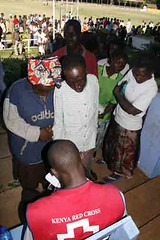
Photo Credit: Red Cross by DEMOSH. Caption: "Internally displaced people queue to register for the food rations being provided by the Kenya Red Cross in Nairobi" DEMOSH is a photojournalist working in East and Central Africa and based in Nairobi, Kenya. Check out his other photos.


Tuesday, January 29, 2008

Help My Pal Beth Win $50,000 for Cambodian Orphans

My friend Beth Kanter, of Beth's Blog, is working hard to win $50,000 for the Sharing Foundation by January 31, 2008 as part of the Case Foundation's America's Giving Challenge. She asked me to ask you to help.

The Sharing Foundation's mission is to help meet the physical, emotional, educational and medical needs of orphaned and seriously disadvantaged children in Cambodia. Beth is on the Board of the Foundation, and she and her husband have two children, Harry and Sara, who were adopted as orphans from Cambodia.

The way America's Giving Challenge works is that the 8 individual online fundraisers who inspire the most people to donate, will receive $50,000 for their charity.

Beth's friend, Michele Martin, set up a page through Global Giving where you can donate as little as $10 to the Sharing Foundation. You can also help by spreading the word. Beth has set up a wiki with information, photos and a fundraising widget that you can include in an email or blog post.

Right now the campaign is in first place with 812 donations (you can see the leaderboard here), but it has to keep up its momentum though January 31st 'cause the other campaigns aren't far behind them.

Thanks for giving and/or spreading the word!

Photo Credit: Literacy Students by Beth Kanter.


Friday, January 25, 2008

Spirituality and Social Justice: Is It What We've Been Waiting For?

I watched an interesting interview on The Daily Show this week with Jim Wallis, the Editor-in-Chief/CEO of Sojourners. You can watch it here. During the interview Wallis said,
"The two great hungers in the world today are the hunger for spirituality and the hunger for social justice. And the connection between the two is the one the new generation is just waiting for."
This isn't a new topic for Wallis. Kathy Pozos posted this quote by Wallis on her blog post, Spirituality and Social Justice - Quote of the Day:
“The connection the world’s waiting for is to connect the hunger for spirituality with passion for social change. Because spirituality, when it isn’t disciplined by social justice, in an affluent society, becomes narcissistic. We buy the books, we buy the tapes. We hear the guru speaker. Barnes & Noble has a whole wall of how to be spiritual, balanced, healed, whole. Spirituality becomes a commodity to be bought and sold. So spirituality has to be disciplined by social justice."
Wallis was on the show to promote his new book, The Great Awakening: Reviving Faith and Politics in a Post-Religious Right America. In his January 18th blog post, Why I Wrote the Great Awakening, he explains:
The Great Awakening explores the new broader and deeper faith agenda and shows how a new spiritual 'revival' could spark real social and political change. Already, in the early primaries the clear victor is 'change,' revealing the deep hunger in America for a new direction in politics, which many on both sides of the spectrum believe to be badly broken. All the candidates are now competing to convince voters that they are the best change agents. . . .

. . . I am not just saying that another Great Awakening may be coming. I'm convinced that it has already begun, and the book begins to tell its stories. As I've often said, this could be a revival that calls us to find common ground by moving to higher ground. It could transcend traditional divisions and bring people together across the theological and political spectrum on the major moral issues of our time. It asserts that religion should not be a wedge to divide us, but a bridge to bring us together."
What Wallis said resonates with me. I think that as the world gets "smaller" people are becoming more aware of how interconnected they are.

Martin Luther King, Jr. described it well in a speech he gave that Joan posted on her GlobalGiving blog.
"All of life is interrelated. We are all caught in an inescapable network of mutuality, tied to a single garment of destiny. Whatever affects one directly affects all indirectly."
The Dalai Lama echoes this sentiment in a quote posted on Mary Ann Testagrossa's Wire Jewelry Blog.
"Today, more than ever before, life must be characterized by a sense of universal responsibilities, not only nation to nation and human to human, but also human to other forms of life."
During the interview, Wallis also said that a "whole new denomination" is growing across the country, people who identify themselves as, "spiritual, but not religious."

It makes sense to me, that if through whatever belief system, more people believe in our interconnectedness, that can produce greater compassion, which provides the fire to take action for social justice.

What do you think?

Photo Credit: Prayers by Giulio Bernardi.


Friday, January 18, 2008

The Op-Ed Project: Writing to Change the World

I've never written an Op-Ed piece, have you? Seems like a good skill to have these days, especially for nonprofits trying to get the word out about their cause.

Unfortunately, if you are a woman, you are less likely to share your opinion on the Op-Ed pages. According to the New York Times article, Stop the Presses, Boys! Women Claim Space on Op-Ed Pages, "Many opinion page editors at major newspapers across the country say that 65 or 75 percent of unsolicited manuscripts, or more, come from men." The article profiles The Op-Ed Project, a training created by writer Catherine Orenstein to teach people how to write for the Op-Ed pages.

Here's what MojoMom had to say about taking the course:
"I was blown away by my recent experience taking Katie's day-long seminar. Even strong and accomplished women may have never thought of publishing an opinion piece before. Feminine socialization is a factor. 'Nice girls' don't make a fuss, and even powerful women can have difficulty claiming their authority. Katie teaches her students how to push beyond that feeling so that we get our ideas out there. When she asks students, 'What are you an expert in?' she has never met a man who says he isn't an expert in anything, but women regularly answer this way."
Staff from nonprofits like Human Rights Watch, the Global Fund for Women, Women’s Funding Network and SheSource.org have taken the training.

If you live in New York, Lindsey Pollak has posted a special code on her blog that gives you 10% off registration for the February 23rd Op-Ed Project class in NYC. Pollak reports, "I have taken this class and it's really excellent."

If you want to get a better idea of what the training entails, the Urban Unrest blog has posted the curriculum from the 4-session teleseminar Orenstein taught for The SPIN Project last fall.

For more information about attending a class, check out the upcoming classes being hosted by the Woodhull Institute for Ethical Leadership, or contact Catherine to schedule a training for your organization.

Photo Credit: Perspective II by Editor B/Bart.


Wednesday, January 16, 2008

Preventing Human Trafficking: An Interview with Christina Arnold

"I think a lot of people perhaps have gotten a one-sided understanding of this issue of trafficking. They see it as coercive prostitution, or just see prostitution as synonymous with trafficking, which is really not the case.

More than anything else in my 10 plus years of experience working on this issue, and living in Southeast Asia, my colleagues and I have seen that trafficking really is about a lack of economic opportunity, and it's not so much about sexual slavery or forced prostitution."
--Christina Arnold, Prevent Human Trafficking

Christina Arnold is the Founder of Prevent Human Trafficking, a DC-based nonprofit working to prevent human trafficking, particularly in Southeast Asia. I interviewed Christina for the Big Vision Podcast last month. Below is an edited transcript of our conversation.

Christina Arnold: My name is Christina Arnold, and I'm the founder of Prevent Human Trafficking, formerly Project Hope International. We work primarily in the Washington, DC area and in Southeast Asia to promote programs that are addressing the root causes of human trafficking, and to provide sustainable alternatives to trafficking.

We have financed many micro-credit loans for women and men who want to start their own businesses as an alternative way to make a living for their families so that they're not circumstantially forced to take work that would be degrading or demeaning to them.

We do a lot of education here in the Washington, DC area, actually all over the United States. We lecture, and we're also trainers with the US Attorney's Office, so we've given trainings to police on how to identify victims of trafficking.

We have an annual study tour that we do every year to Southeast Asia for scholars, researchers, academics, students, funders, you name it, who would like to get outside of the bubble of the United States and see firsthand the circumstances that people endure, and where people are at, and what this looks like on the ground, especially in some of the very at risk areas along the Thai-Burma border, the border with Laos, and also in Vietnam and Cambodia.

Britt Bravo: On your website, you have several videos and on one of them you said that the reason that Prevent Human Trafficking exists is to help people come to terms with the real facts on trafficking and the larger, bigger issues around this issue.

CA: Right.

BB: What are the real facts?

CA: I think a lot of people perhaps have gotten a one-sided understanding of this issue of trafficking. They see it as coercive prostitution, or just see prostitution as synonymous with trafficking, which is really not the case.

More than anything else in my 10 plus years of experience working on this issue, and living in Southeast Asia, my colleagues and I have seen that trafficking really is about a lack of economic opportunity, and it's not so much about sexual slavery or forced prostitution.

I would say that the majority of the cases are people who've been displaced by war or political conflict, especially in Southeast Asia, and they were forced to get into a kind of work. Many times they arrange their own transport. They agreed to be smuggled. They pay a smuggler to take them across the border to get them work, and then are tricked along the way and wind up in the fishing industry, wind up in very exploitative situations as domestic workers in people's homes, or factories, things like that.

A lot more airtime has been given to sex slavery, especially here in the United States, and researchers have found that a lot of this talk is unsubstantiated by research. There is actually a great piece by a professor at George Washington University, Ronald Weitzer. He wrote a brilliant piece about the moral crusade of this issue, and that's not to say that it's not to be taken seriously. I think that we need to look at the root causes for why people wind up in exploitative situations, no matter what they are, and to say that someone who is a victim of labor exploitation and trafficking deserves equal voice with someone who has had a different experience.

I think now more research is being done to point to some of the assumptions that have been made about the human trafficking "industry", if you will, to separate out the myths from the facts, and to give people a clearer idea of what we're really looking at, especially when we talk about numbers of trafficking victims.

There was also a fantastic article from the Washington Post about this very issue of numbers. They said that it's very hard to communicate to people the gravity of the situation with human trafficking unless you can put numbers around it. But they haven't found that the numbers have added up here.

If you put them next to what the Department of Justice and the Department of State put out as the official numbers, they've not been confirmed or substantiated, so people are starting to take a more nuanced, critical view of this issue of trafficking, especially if we're looking at outcomes, and what has been done in the last 10 years to really change the situation of trafficking. Have the programs that have been funded done enough to make a difference on this issue? Where is the research funding being given? People care deeply about this issue, but I think asking the hard questions, and looking for outcomes, and looking at root causes is something now that's being considered a lot more seriously.

Britt Bravo: Since what you're saying is that he definition of human trafficking is much different than what many people think of, can you tell a story of an actual person and what that means, or what that looks like, or what their experience is, and if it's a success story, even better, of how they survived? I think that helps people to understand what something is really about if it can be placed in the context of a story of a real person.

CA: Without giving names, along the Thai-Burma border there is a project that we're funding with a fantastic former Thai Senator, Mechai Viravaidya, who is also the Chairman and Founder of the Population Community Development Association of Thailand. They have an incredible grassroots network in some of the hardest to reach villages where people are most at risk, for all sorts of reasons.

We've partnered with the Partnership for Trafficking Prevention to provide micro-credit loans and education in these border towns. We've received news back that in one village, before the program was started, they had more than 17 families that had relatives or family members go into the sex industry, and other forms of exploitative labor, because they said that they just had no options, and people were desperate. They believed these talent scouts that said that they would find them good work in the city. Since this collaborative project has been in place, only one person has left the village. In a year, that's pretty outstanding.

People will tell you pretty straightforwardly, "The reason that I sent my son or my daughter, (or my whoever family member) to go and work in a big city is because we're completely out of options here. Our rice crops have failed, and we don't know what to do. We keep having more and more people come across the Thai-Burma border. We need work that can sustain the village community."

There was a woman I met a couple of years ago who said that all she ever wanted was to build her own noodle shop. When I asked her how much money that was and how she was trying to save for it, she was in a shelter at the time. She said that first she started out as a domestic worker, and then wound up in sex trafficking. She said that two hundred dollars was the amount of money that she was trying to save up.

After working for more than seven years, she hadn't even been able to save a fraction of that money that was needed to fund her dream. That's the most exciting thing for us is to be able to say, here is a real problem that exists, people know where these vulnerable populations are, and we can fund these enterprises that allow, not just that person, but their whole family and the whole community to be able to sustain themselves. That's a pretty powerful thing, and it's proof that it is possible to prevent human trafficking before it begins. That's probably the clearest example I can give you of how these programs work when the villagers themselves say, "Oh, yeah, a year ago this many people went missing from our village and this year only one person."

BB: In the same video you talked about how a lot of the solutions that you're working to support, the people in the community come up with them and they are the ones implementing them. What are the solutions that the communities have come up with, and also, it sounds like micro-loans are one way to prevent trafficking. Are there other tools? What are other ways to prevent it?

CA: Lack of education about people that are in search of people in desperate situations that can be lured into these exploitative jobs is a big part of it. Many people, especially in the up country areas of Thailand, along the Burma border, are not necessarily talking to each other and getting the information about what happens to people's family members especially, when they came home sick, or didn't come home at all.

We found out, after having a consultation with the village leaders, that they said that if they could have forums, or if they could have a play, a street drama, where people could do a retelling of some of these stories, without putting attention on one particular family, then this would raise the awareness of everyone in the village to the tricks and the ploys of some of these traffickers.

For example, one family had somebody who had a really fancy rented car, borrowed fancy jewelry, and nice clothes on show up at the door of a poor rice farming family, who was in a little shack without running water or electricity, and say, "We've heard that your family is very hard working, and we're here to offer you a job. We're starting a new restaurant in Bangkok or whatever," It's very hard, I think, for some of these people to see, "Oh, that's one ploy of traffickers."

Putting together those stories and experiences, and then being able to have a community put on a theater of sorts, like street theater, or sit and discuss it. One of the ideas that they came up with, which they started years ago with the Population Community Development Association of Thailand, was to have village banks. What would happen is that many times someone in the village -- say, for example, their rice crop didn't yield, or they ran into some other trouble, or a family member died and they needed to borrow money for the funeral-- would wind up getting very deeply into debt with some of these loan sharks because they didn't have access to credit, and they had no extended family to borrow money from.

They set up a village bank where everyone in the village invests money in the village bank, and then once a month they have a meeting and decide who in the community is in an emergency situation. They vote to let them borrow from this village bank, and that's a community solution that's worked very, very well for them.

Again, asking the question, at what point did people fall into debt? What happened to get them into the situation where they were so desperate that they wound up in these exploitative situations?

BB: What brought you to this work? Why do you do this work?

CA: I guess my whole life has been preparing me to do this work. I was born in India, in Bombay, and I have four brothers and sisters. There were five of us that were born in South and Southeast Asia, and I lived there until I was 21.

When I was growing up, I was very aware of the class differences, and the different ways that people would treat children who were from lower class families. I also lived in Sri Lanka right about the time that sex tourism became a big deal, and saw it firsthand. I spent a lot of time thinking about why these things happened to people that are just poor. They don't have the resources to be able to do better by their family, and you see that it goes on through generations. Wanting to do something to help change that has been a long journey.

I came to the States for the first time when I was 21 to live and brought with me this idea that started in Thailand, when I was working in some of the orphanages there, hearing stories that sounded very similar to stories that I'd heard in other countries in Southeast Asia.

At that point we didn't have a name for it. Human trafficking hadn't been institutionalized, and the U.S. didn't have the Trafficking Victims Protection Act yet, that was passed in 2000. I found a really amazing group of people here in the States that really wanted to do something to help change circumstances for people in these situations.

It started out small. It started out actually with a Rockefeller Grant to do a study trip back to Thailand, and the area, to find out what was being done for at risk populations. That's grown into an every-year trip back to that part of the world to continue doing research, meeting with community members, and keeping those ties strong with the grassroots networks that we built over the last eight years.

It's a pretty neat thing to be able to link the experiences that people are having in South and Southeast Asia with what we're seeing here in the U.S. There are trafficking situations. People are looking at this issue now, taking it seriously. I just think more focus needs to be put on root causes, and put on prevention. The State Department actually has within its mandate prevention. They have the three P's, as they call them - prosecution, protection and prevention. Prevention has not been given much funding, and I think that we can see now after almost 10 years of work on this issue that some things are definitely being understood better, like the whole debt bondage situation. That's mostly why people wind up trafficked, and that was just highlighted in this year's Trafficking in Persons Report from the State Department, which was encouraging as well, because it is now giving more attention to the plight of people who have been trafficked into exploitative labor situations as well.

BB: And if you had unlimited resources and funding, what would be your dream project or program?

CA: I actually have a dream project that we are trying to figure out how to get funding for. It is an observatory to study human trafficking in Southeast Asia, and it is a group of academics and researchers and activists from all over the world. I'd say we have got more than 15 people on-board now for this idea, which is to put all the research that has been done on this issue into one place where people can access it. We can do more on both ends to figure out how to be most helpful to the organizations that are providing services and dealing with this issue on the frontlines by asking, "Is the grant funding going where it should go," and "what are the effective practices that we can promote." I think a lot more attention could be put on that. We are just looking for funding for it now.

It is pretty amazing the person that is heading up this initiative is actually going to be coming to the U.S. in April, and we will be doing a lecture and documentary screening tour with him. His name is Pierre Le Roux and he has researched in that area for 25 years, speaks five languages, and has a very strong, more than a feeling, he has a very strong opinion that human trafficking can be stopped.

He has real numbers, and he says that people tend to get very depressed about it, because it seems so overwhelming, but with this observatory, the idea would be to get all of the intelligence that we have on trafficking, and things like, where trafficking victims are coming from, what are the top reasons that they are winding up in these situations, and get some of the best minds involved to come up with substantive information that can actually make a difference to the lives of people who are being affected.

BB: For people who are listening, who are feeling like, "I want to do something about this, either I want to support to Prevent Human Trafficking, or just help some way overall, " what can they do?

CA: Anything that you can imagine. We need all kinds of help, anything from donations to getting involved with helping to fundraise for this observatory, to going overseas. If it is a donor, or somebody who wants to get involved in funding sustainable solutions, we take people every year in the summer to visit the projects first hand and see what is being done over there. In kind donations of all kinds, office supplies, donating miles that people can go and work with some of our partner organizations in Thailand.

Every year we send all kinds of volunteers who would like to spend three months or more volunteering their time with partner organizations. That is something that has really been meaningful on both ends for the people that go, and then also for the organizations that are grateful for their help.

We have a scholarship fund that gives scholarships to at-risk children along the Thai-Burma border; that is something else that can be gifted in honor of family members. A lot of people like that. Someone donated a yacht to our organization this year! That was probably the most interesting donation we have gotten. Computers, anything you can think of, we will find a way to use it to advance the cause.

BB: Is there anything else you want people to know about the issue of human trafficking?

CA:
I think that something that is very important, especially for the second generation of human rights activists that are interested in this issue, is that the desire to get out there and do something, to help stop human trafficking, is something that is felt by a lot of people now that they have seen the Lifetime series on human trafficking, and different documentaries that have been circulating.

It solicits a very emotional response from people, people who want to go on their spring break and go and free victims of trafficking in various parts of the world where they may not speak the language. I think they need to take an optimistic view first off that yes, everyone can do something to stop human trafficking, but then think about how their skills can be best used, or how they can be most effective in that goal that they have of wanting to ameliorate human suffering.

I think that we hold tremendous power in our hands. I think everyone whether it's volunteering a couple hours of their time or helping to translate documents, or doing something that contributes in a serious way to an organization's effort is more useful than, I think, hopping on a plane and going out with the aim of rescuing victims of trafficking from various parts of the world.

I think that working here in the United States is important too because a lot of the organizations that we are honored to work with in that part of the world have told us that it's the access that we are able to provide them to organizations and caring individuals here that allows their work to continue.

For example, Dining for Women is a fantastic organization that promotes the idea that chapters all over the country can donate the money that they might have spent on a meal out to an organization that is working to promote human rights, women's education and sustainable programs such as the ones we run. They actually raised over $13,000 for a project of ours along the Thai-Burma border, which was phenomenal, and that is something that anybody could do. Anybody could join their effort and start a chapter in their own neck of the woods. I think that approach, funding sustainable work that is being done, maybe people can't travel all the way over to Thailand, but in their own backyards, they can do a lot to change the lives of people that otherwise would not have any options.

Related Blog Posts:
Dining for Women's post about raising money for Prevent Human Trafficking.
Jay Dedman's post about spending 3 weeks in Southeast Asia with Ryanne Hodson videoblogging for Prevent Human Trafficking.
Prevent Human Trafficking's video blog.

Photo used with permission from Prevent Human Trafficking. Christina is in the pink shirt.