Wednesday, November 12, 2008

Small Groups Can Change the World: An Interview with Marianne Manilov of The Engage Network


"It's not how many friends you have on Facebook, it's the depth of connection of our community ties that will keep us together and allow us to have political power together."

Last week, after the election, BlogHer co-founder Lisa Stone, asked What Will You Do To Change America? I wrote a few suggestions for how to figure out how you want to create change in my post, How Can You Make An Impact? including finding a small group of people to support you in your process.

The Engage Network is a nonprofit social venture that facilitates the power of small community groups to create social change. At the moment, The Engage Network includes three "sectors": What's Your Tree?, inspired by Julia Butterfly Hill's tree-sit, Off the Mat Into the World, founded by yoga teacher Seane Corn, and Green for All, founded by Van Jones.

On October 21, 2008, I interviewed Marianne Manilov, the National Team Leader at The Engage Network, about their work. Below is an edited transcript of an interview, which you can also listen to on the Big Vision Podcast.

For folks who don't know, what is The Engage Network?

The Engage Network is a new nonprofit/for-profit venture started two years ago. Its main purpose is to help people really get engaged on the ground in social change. We do that through a model of living room circles, circles in cafes, and circles in yoga studios It's a place for people to actually plug in and get trained to be leaders.

The Engage Network site features three sectors which are three very different programs. What's the connection between these programs, and how do they fit into The Engage Network?

Well, I think what you have to look at is, when people come to get involved in social change, how does that happen? You see somebody who inspires you. You see, perhaps, Julia Butterfly Hill, who sat in a tree, or you see Van Jones, who's the leader of Green For All, or maybe you see somebody else. You hear them speak, or you read their book, or you listen to your podcast, and then you generally write to that person, or you go up to them, rush them at the end of a speech and say, "I'm a student, I want to get involved."

What they're going to say to you is, "Join my email list." That email list is going to give you updates once a quarter. Maybe you're going to get involved in a day of action. Maybe you're going to give money. That's kind of the trajectory for how we get people involved.

The Engage Network was founded when Julia Butterfly Hill had a major motion picture coming out about her, and we saw what had happened with An Inconvenient Truth. Actually, it started a little bit before An Inconvenient Truth, but essentially, people got really excited by Al Gore's message, he's a social champion, somebody who inspires us, and then they really didn't have a lot of ways to plug in.

Of course, this incredible film was produced in a short amount of time, without a lot of budget to do outreach. I think they did a great job of trying to give people 10 actions, but a lot of it was "Change your light bulb," or "Buy a Prius." It really wasn't how most of us felt after seeing the film, which was, "I want to truly get involved." Most of that was picked up by Billy Parish and the people with Energy Action Coalition, and It's Getting Hot In Here.

So, we're looking at, how do we partner with people who inspire people? Right now we have three partnerships, one is with Julia Butterfly Hill, who sat in a tree for a long time; one is with Seane Corn, who is a nationally known yoga instructor, but she's also known for her work working with child prostitutes and young people with AIDS; and Van Jones.

We're looking at partnering with people who really inspire, and giving people a way to plug in on the ground after those people leave. So, if you see Van speak, our goal is to have a place that you can plug in, a local leader who says, "Come to my house."

The commonality between all the programs is that we will help you find what it is that calls you, your purpose in social change, and build you a community of friends who have a deep connection to you, so if you get sick, or you need something, they're going to be there for you, and then have you start taking action in the world. That's the trajectory that we're really looking at for Engage. We're looking at taking people beyond that, "I want to be on an email list," into action in their own communities. The difference is that we're partnering with different social champions.

On the site, you have different influences for this organization. A lot of them were books like, The Starfish and the Spider, The Purpose-Driven Church, and Blessed Unrest. Can you talk a little more about the kind of the organizing model that this is based on? You've touched on it a little bit, but maybe go into it a little bit deeper.

Again, just to tell you that story, what had happened was that Julia Butterfly Hill had this major motion picture coming out, and to give you a sense of what that meant, An Inconvenient Truth opened in about four theaters, and maybe expanded to 20 or 30. Julia's film will likely open in 1,500 theaters, on the low end. She really wanted a way to get people engaged that wasn't just, "Get on an email list".

Then her film was delayed. It's still delayed, actually, we're waiting for it to go into production. She said, "If you could do anything, what would you do?" A team of us said, "We would study what works in citizen engagement." So, we spent a year, and a significant amount of resources, close to half a million dollars. A team from Circle of Life, and myself, went around and started studying organizing models.

What are the things that I've seen that have worked? The first one for me, as somebody who's a progressive, was the Howard Dean community. They had an amazing network on the ground, volunteers. I tracked down some of the Howard Dean guys. I'm particularly influenced by a guy named Michael Silberman. He's with EchoDitto, now working with One Sky. I had to beg to drive him to the airport to even get any time with him, because he had no idea who I was. I'm an older organizer, he's the next generation.

For me, what was key about him is he was the person, when Howard Dean was building living room circles, that was building the leadership of each of the leaders who was running a living room circle. He was actually dealing with those leaders, helping them build skills, helping them be inspired, and he was their coordinator. I wanted to know what worked, what didn't work, and what did he learn. He was a very big influence.

We also looked to the business community. There was this book, The Starfish and the Spider, which studied things like Craigslist, which is a distributive model of people being able to post things online.

Strangely enough, I read that book about three times, was obsessed with it, and then realized the third time through that one of the authors had organized under me when he was in college, so I called him. He became an advisor, not just because of what was in the book, but everything he had been studying. He'd been going around the country looking at everything from disaster sites, to CEOs of corporations, and seeing how people were empowered from the ground up. Even though it was a business book, The Starfish and the Spider, it was really looking at, how do we distribute power in a network so people feel like they can take action? His name is Ori Brafman.

I met with people like Erin Potts, the founder of the Students for a Free Tibet concert series. She engages students at a concert level. What had she learned, what had she studied?

We started to see some common themes. Our biggest breakthrough, I think, in that year of study, came when we decided that if we're going to really understand organizing, we can't just study progressives. We have to study the right. We knew that the last election was given to Bush by the evangelical Christian movement, so we thought, we have to go in and study this.

Myself and Alissa Hauser, who was Julia Butterfly's Executive Director, and a Board member of Circle of Life, and Ina Pockrass, went to Rick Warren's church. Now we all know who Rick Warren is because he hosted a debate; at that time nobody did. He's the founder of this network called The Purpose-Driven Network based on the Purpose-Driven Life book series. He had a conference about how to build a purpose-driven church.

I remember being there at that conference, we registered as a church (in my personal life I am an assistant minister at a place here in Oakland), and I was expecting to be very uncomfortable there, but I was very comfortable in that community. I was surprised how welcoming they were to people of all different faiths.

It was a very interesting community. We were there for awhile studying, and I remember at one point thinking, "This is going to change my life." I called Van Jones on the phone, because we're good friends, I was crying, and I said to him,

"I have done 20 years of organizing one way, and I did it the wrong way. Now at least I have a beginning of what we need to do right. If they don't pay me for the rest of my life, this is what I'm going to dedicate my life to."

What moved me so much was that, in organizing, when I've worked on national campaigns, our job is always to go to leaders, whether that's a union leader, or an environmental organization, Sierra Club, whoever it is, on a piece of legislation and to say, "Excite your leaders. Go out, call them, get them engaged."

That is a model that I call "Core to Community." A core group of leaders who, in the organizing movement, happen to be predominantly white men (still) who are in positions of strong power, who are trying to excite a base of people for a period of time on a certain issue.

Small group to large group, issue-based, short-term. Not so great. There are base-building groups, we have ACORN, I'm not saying the movement doesn't have that, but their predominant methodology was, take people who have never been involved. In fact, Rick Warren, in starting his church, one of the first things he said was, "If you're involved in a church, I'm not interested in you." He's looking for unbelievers. The progressive movement never does that. We are completely looking for people who've already bought every single solitary thing, myself included.

He takes them through a process of building them up from Community to Core through building them up into small groups who take care of each other, and learn to change the world together, and he actually has a social justice framework.

Of course, as they're coming through that network from Community to Core, he also wants them to accept Christ into their life. So, he has a spiritual goal for them. Being a spiritually mature leader, in my worldview, is not a bad thing. The people I work with in organizing who are what I would consider spiritually mature leaders — it's a great thing.

He takes them through both that process of skills building, of how to run a group and build other leaders, and also a spiritual maturity process. In his church, he has over 3,000 small groups. Those groups are always happening, always taking care of someone. If someone goes to the hospital, who takes care of them? The small group. If somebody needs childcare, who takes care of them? Their small group.

If he wants to do a political campaign, he's going to say, "For the next 40 days, I want you to feed all of the homeless in Orange County." Well, when he announced that to his church, they did 40 days of community service, and 10,000 people signed up.

That's what it looks like to me to change the frame of a small group of people who activate a base for the short term, to a long term building of people through a process of leadership and taking care of each other so that we can build out a movement, and then lay campaigns on that. I feel like we've been doing the opposite, and people feel burned out and disconnected.

We talk about this vision of what it will be like when things have changed. I get a little sense of that from the Obama election, but it still doesn't mean that somebody has childcare who doesn't have it. Until I know in the movement that people who are with us are truly cared for, and truly coming from a place of being called into their greatness, and we have pathways to get them from A to B, it doesn't mean much. We keep talking about it, but I haven't seen much outside of people getting really burnt out, and having to leave to get the care they need.

That's changeable, and I don't think the right-wing churches have a handle on the whole thing, obviously, but they have a best practices network of small groups that I study, and I definitely think we have some of those in the progressive movement. Also, there's a whole church movement that is particularly strong in Africa that also has these kinds of things, and there's social capital that's been studied out of Harvard, how you build social capital. We've combined a lot of those things, and we've come up with a theory of change.

We are testing it on the ground with these social champions, and with curriculum, and with local leaders. It's like the iPhone, version one, lot of glitches. We're probably in version three now, but I don't want to release it publicly outside of our partners, or broadly to the movement, until we get a little bit further down into the versions.

We want to take it to scale and see what the problems are that we come up with at scale in these three programs: What's Your Tree?, Off the Mat, and Green For All. We're constantly failing and finding things that are wrong. That's part of our methodology. We are an organization that's an adaptive organization; we want to be adaptive and constantly changing, and we want the model to actually move and change and grow, but it has to get to a certain level of growth, just like a child does, before it has enough energy.

Van and I spent a lot of time this summer really talking about that, his feelings for Green For All, and my feelings for Engage, that we want to do things in a way that's very intentional, so that as we scale it up to a lot of people, it holds up. Not that it doesn't have some failure; I think failure is a sign of success.

You mentioned that you've been organizing for 20 years. Can you talk a little bit about the path that brought you to this work?

Well, I come from an organizing family, union organizing family. Some people's families are doctors or lawyers, mine's organizers. I was involved from a very young age in many different social change things. As a college student, I was part of the national student divestment movement. I went to the University of Iowa. We took over a building. We locked down.

I was trained by Mel King, a civil rights leader out of Boston, extensively, and I still really identify with a lot of his work. Then I went on to work for Amnesty and Greenpeace, and I've done an enormous amount of youth organizing. I founded a nonprofit with a couple of other women, Robin Templeton, Asha Bandele, and Veronica Sanchez called UNPLUG, and then did consulting, and wrote a book. I was never planning on founding another nonprofit, and definitely did not want to birth Engage. [laughs] But, it became very clear to me, there were many signs, that it was what I was supposed to be part of birthing, and the group that birthed Engage, it called all of us to stand up and do that.

And what is the long-term vision for Engage?

My long-term vision for Engage is, how I'll know it's a success, is when I look back on it (we all talk about being in rocking chairs now because I'm about to turn 43 next week) and when I'm sitting in a rocking chair next to Van, and other people, what I'm looking for is that there is a team of leaders who truly know how to both care for people, and change their world at the same time. That when you plug into the social change movement, what you're going to get first is a sense of community, and a sense of care, and a sense of somebody really looking at you and saying, "What is it you want to do? What is it that calls you to be more than you thought you could be?", and then a team of people that helps you get there.

I want to see that we're having a lot of community care, and we have political power because of that base. Make no doubt about it, the small circle network in the evangelical churches have elected presidents. I believe the small circles that came together around Obama will elect him, but the question is, what happens after a single campaign? Do we stay together and create this kind of community we always talk about, but I don't see in practice that often, except for maybe at a Bioneers conference, or something for a weekend?

That's not what it looks like. What it looks like is Van's wife being able to call me and say, "I need somebody to come get my son today, can you pick him up?" or me being able to say, "I have dental surgery, who's going to come and take care of me?" and knowing that people in the movement aren't going to say, "Oh, you know, I'm working 70 hours a week, I'd really love to be there, but I couldn't." That's not what it is. It's not how many friends you have on Facebook, it's the depth of connection of our community ties that will keep us together and allow us to have political power together.

I want to know people at a deep level. I don't want to know them in passing. I want to know less people, and I want to know them more. I keep looking when people are asking to Facebook me now, and Erin Potts said to me, "You know, I'm really looking at, would I spend a weekend with those people?" I want to know who it is that I'm in contact with because I can't take care of everyone, and I can't be involved in everything, so I want to choose really well.

Can you talk a little bit more about what the three programs that make up The Engage Network are about?

Right now we've partnered with three social champions. One is Julia Butterfly Hill, who had a two-year tree sit, and that program that surrounds her is called What's Your Tree? What's Your Tree? is a program for people who might see her movie, or for the first time are thinking about being involved in environmental or social change. It takes them through a process of finding their purpose, building a community team, and taking action.

Then we have Off the Mat, Into the World, which, as you might imagine, is a yoga program with Seane Corn, that takes yoga leaders, and people in yoga studios through that same process, but also has a very embodied sense of it; the yoga teachers take people through some work. Also, I think it's a little bit deeper work because you're doing work in your body.

Right now we're in the design phase with Green For All, and looking at launching a leadership training program in two to five cities in the spring, predominantly in communities of color, that will build small living room circles as well. With Green For All, there are students who are in green jobs programs, there are people at the city level, there are the student environmentalists, we have to look at all those places and serve many different communities. We'll be piloting in the spring, and then version two.

If people who are listening to, or reading this interview are getting excited about what you're saying, how can they get involved in The Engage Network?

Well, there are two ways to get involved. One is, you can go to the Engage website at www.engagenet.org. The way you enter is through the partner organizations, What's Your Tree?, Off the Mat, or Green For All. You can see if there is a local group in your area. At this point, there may not be, in which case, I would say, there isn't a way to locally get involved. You can sign up and say, "I want to start a small group," but we're not launching in that way.

What I would encourage people to do in the meantime is to not wait for Engage. Find a circle of five of your closest friends and start having a potluck once a week. Start bringing in readings, talk about your visions and your dreams, and what it is you want to do, and how you want to be there for each other. Make a commitment to meeting for six months, or a year. Your ability to build community among your friends who you want to do social change with, and to stay in that community changes the world.

We now know that groups of people who are strongly tied together, there are government studies, Harvard studies, that show us this, vote more often. They're less sick. They're less in poverty. Once that group of people has met for six months, and really spent some time internally getting to know each other, I mean, like, six months, a year, maybe think of one thing you want to take on together. Or, go around and each person gives a vision, and say, we're going to take on the vision of one person for a couple of months.

That's the process. We're doing it through curriculum, and looking at scale, but you don't need us to do that. As much as I love Facebook and MySpace, that isn't what is going to build us a movement, so be willing to be bold and take the next step into movement. We're not the only group that's doing small groups, the Howard Dean group went into Democracy for America. Look for groups that have that ability to train you as a leader on the ground, and really tie deeper into your current community.

Is there anything else that you didn't get to talk about, either about The Engage Network, or your partners, or the work that you've done that you want to share with folks?

I think it's an incredible time. When people are feeling this call to get plugged in, it is hard to take that first step. I say to people, the first step is a potluck. You've seen what people around the country making a few phone calls for Obama has done. We're going to elect a president. 3.2 million people giving money, 82 or 86 dollars.

See, that one step of community, it's a very valid step that, for whatever reason, the movement left behind. Realize that the Civil Rights movement, the women's movement, the anti-slavery movement, there isn't a movement that was successful without those kinds of small living room circles. Stand in that and know that once a month, or twice a month potlucks can change the world.

Photo: The Engage Network Founders: Marianne Manilov, Ina Pockrass and Alissa Hauser.
Cross-posted from BlogHer.


Tuesday, November 11, 2008

Make a Difference From Home: Be a Virtual Volunteer

You're busy, but you want to volunteer--why not try being a virtual volunteer! Virtual or online volunteering allows you to do your volunteer work online.

Wondering what kind of things you could help with?


In his post, Become a Virtual Volunteer and Make a Real Difference, Jeff Nickles of My Super Charged Life points out that nonprofits need all kinds of help that can be done online:
"[V]olunteers are needed in researching topics, editing documents, developing web sites, writing proposals, creating curriculum, tutoring students, designing graphics, and editing video, just to name a few possibilities. In addition, organizations need online volunteers with legal, financial, environmental, information technology, and project management expertise."
In her post, Be a Virtual Volunteer, Karama of the blog, So What Can I Do? also has a list of ways you can help including: grant writing, website or graphic design, being an email pen pal, raising money on eBay, transcription or translation, research, database development or management, and copy editing.

TheSite.org also has a long list of virtual volunteer ideas in its article, What Can a Virtual Volunteer Do?

Are you inspired and ready to find a virtual volunteer opportunity?

In addition to the United Nations Volunteers Online Volunteering Service that I posted about last week, you can also search for virtual opportunities on VolunteerMatch, ChristianVolunteering.org, Idealist.org, and DoSomething.org. You also might want to check out ServiceLeader.org's Virtual Volunteering: Questions from Volunteers for more ideas and information about being a virtual volunteer.

If you're interested in social entrepreneurship, Ashoka and the Ashoka Fellows are always looking for virtual translators who speak Spanish, Portuguese, French, German, Polish, Arabic, Hebrew and African and Indian languages.

Where else can people find virtual volunteer opportunities?

Cross-posted from The Extraordinaries.
Photo of virtual volunteer cat by me.


Be Bold Podcast: Create a Career with Impact, Episode #3

The third episode of Echoing Green's Be Bold Podcast, that I host, is up. The show features a discussion of two career related questions with Lara Galinsky, author of Be Bold: Create A Career with Impact.

The questions are:

1. I recently quit from an organization where I worked for the last 11 years. I haven’t decided what to do next and am considering doing consultancy work. How do I market myself given that I’ve never done this kind of work before?


2. I am currently completing a Ph.D in Anthropology with a focus in U.S. Historical Archeology. I am now interested in pursuing a career with either a nonprofit or NGO abroad, working primarily in the area of education and educational development policy. My question is twofold:

a. How do I now market myself for this field when most of my education and research has been in another field, and primarily in the US.

b. While looking for organizations to apply to, I have not had much luck in finding any geared towards education, and education development abroad. Are there any particularly useful websites, or organizations that I could direct my search to?


You can listen to the Be Bold podcast online, or subscribe via iTunes.

Send in your questions to be answered on the Be Bold Podcast to bebold@echoinggreen.org. Also, check out the Be Bold Resources page, and the New York Times' Social Impact Career Center, created in partnership with Echoing Green.

Finally, the deadline to apply for an Echoing Green Fellowship for social entrepreneurs is coming up: December 1, 2008.


Friday, November 07, 2008

November 10: Bloggers Raise Awareness About Refugees During Bloggers Unite

Monday, November 10th, in an initiative similar to Blog Action Day, thousands of bloggers will post about refugee issues to raise awareness as part of Bloggers Unite.

The Bloggers Unite site has Bloggers Unite for Refugees digital badges you can add to your blog or website, as well as links to information about refugee issues:


All kinds of blogs are spreading the word and planning on joining Bloggers Unite like:

Medusa's Muse, a blog by the publisher and owner of an independent press in Northern California of the same name.
Flavours of Italy, the blog of Flavours Italian Cookery Holidays, an Italian holiday tour operator.
Traveling Project, a travel blog by "TravelDude."

This isn't the first Bloggers Unite campaign. In the past, bloggers have written posts on the same day about human rights, acts of kindness, abuse, and organ donation.

Cross-posted from BlogHer.com.


Change.gov: President Elect Obama's new site

I've been following Barack Obama for about as long as I've written Have Fun * Do Good:

• I wrote about his podcast in September 2005: Obama's podcasts and Clinton's version of Slamdance.

• Listed Dreams of My Father as one of my Favorite Do-Good Books of 2006.

• Saw him speak in 2007: Obama in Oakland.

• And saw him speak again in 2008 at the September 11 Presidential Forum on Service.

But today is the first day it feels real. Barack Obama is going to be the President of the United States.

Wow.

Wow.

He has an amazing new site up, Change.gov: Office of the President-Elect. It has a newsroom and a blog, and information about their agenda, how to apply for jobs, and how to be of service.

It also has a place to "tell your story" about what this election and campaign means to you, as well as a way to share your vision for where Obama should lead the country.

It gives me the shivers. To be asked. What I think. By my government.

I don't think I've ever written that. My government. My government.


Wednesday, November 05, 2008

How Can You Make An Impact?

"So let us summon a new spirit of patriotism, of responsibility, where each of us resolves to pitch in and work harder and look after not only ourselves but each other."
--President-elect Obama's acceptance speech
November 4, 2008

In her post today, Congratulations President-elect Obama: Now, BlogHers, what will YOU do to change America?, BlogHer co-founder Lisa Stone asks us to make our own "transition plan," and ask ourselves how are we are each going to help create change in America.

To figure out how you can make an impact, try this exercise based on a similar one from Carol Lloyd's book Creating a Life Worth Living:

1. On a blank piece of paper write (without editing) a long list, or create a mind map, of all of the issues that are important to you (i.e. health care, education, foreign policy, the arts, crime, poverty, animal rights, environment, local politics, organic food). You can be as general or specific as you like.

2. On a second piece of paper, write (without editing) a long list, or create a mind map, of all the skills (personal and professional) you like to use (i.e. research, construction, making music, translation, driving, cooking, organizing, presenting).

3. You can do this third part alone, but it's even better if you can find a friend, or group of friends to brainstorm with. Take a final piece of paper and write, without editing, or create a mind map, all the ways you could use the skills you enjoy to work on the issues that are important to you.

4. Look through your list and mark the three ideas that you are the most excited about. Your ideas may be life changing, like entering the Peace Corps, or smaller changes in your daily life, like volunteering one morning a week at a public school in your neighborhood.

5. Write down three small actions you can take toward exploring one of these ideas. Ideally, the actions would take somewhere between 30 minutes-2 hours, so that they feel doable. Mark a date on your calendar when you'll complete your actions. When that day arrives, pick three new, small actions towards the same idea, or a different one.

6. Find a small group of people to share this process with on a regular basis. I'll be posting a transcript this week, or next week from my Big Vision Podcast interview with Marianne Manilov of The Engage Network. She talks about the power of small groups to change the world.

"Never doubt that a small group of thoughtful, committed citizens can change the world. Indeed, it is the only thing that ever has."-- Margaret Mead

***************************************
How some bloggers are changing the world:

Julia of How I Changed the World Today regularly documents the loans she makes to to social entrepreneurs on Kiva.org.

Karama of So What Can I Do? posts ideas for how you can change the world. In today's post, Join the Carnival of Change We Can Believe In (Booth 11) she suggests supporting Obama's presidency by: 1. voting for every position in every election, 2. serving jury duty (willingly), 3. writing to your elected officials, and 4. running for political office.

As part of Art Every Day Month, Jennifer of the Life Unfolds blog is creating collage cards for each of her core values. She is also the creator of the Unfolding Your Life Vision Kit.

Cross-posted from BlogHer.com
Flickr photo credit: American Flag, Navy Pier, Chicago by Belinda Hankins Miller.


United Nations Volunteers Launches New Online Volunteering Site

Have you ever wanted to translate newspaper articles from Turkish to English for UNHCR (United Nations High Commissioner for Refugees)?

Help the UNDP's (United Nations Development Programme) International Poverty Centre forge research partnerships in the Arab States region?

Do graphic design for Lawyers without Borders?

Provide CiviCRM and Drupal support for the Aid Workers Network?

Write a great apes species profile for the African Conservation Foundation?

You can find online volunteer opportunities like these from UN agencies, and development organizations on the UNV Online Volunteering Service. The UNV recently updated its site to make it easier for individuals to find online volunteer opportunities, and for organizations to post them.

Mrs. Rizki of the Mr. and Mrs. Rizki blog, has been a member of the UNV online volunteering community for 5 years. She recently signed up to do some translation:

"I found this organisation named PEOI, which specializes in providing free online education for several countries, including Indonesia. I, basically translate their English contents to Indonesian."

SanityFound's Ramblings joined the United Nations Online Volunteer Programme when she was home with extra time on her hands:

"I loved the concept of being able to help the Developing Nations while I worked as I was not in a position to join the full time volunteer programmes."

You can search for volunteer opportunities in English, French or Spanish by task, development topic, and region. Best of all, all of your work is done online, so you can fit it in to your schedule!

Have you ever been an online volunteer for the UNV? What was it like?

Cross-posted from The Extraordinaries


Friday, October 31, 2008

Social Media for Nonprofit Best Practice: Don't Forget to Tell Your Supporters How to Use the Tools

Increasing numbers of nonprofits are using the social web on their sites, but what I don't see enough of is explainations for their constituents of how to use these tools.

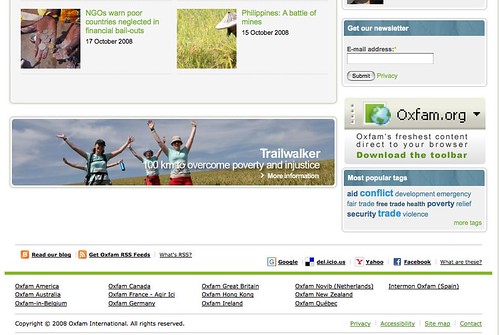
Oxfam International does a pretty good job of educating their supporters. On the bottom of its home page it has links to its rss feeds as well as to Facebook, del.ico.us, Yahoo and Google:


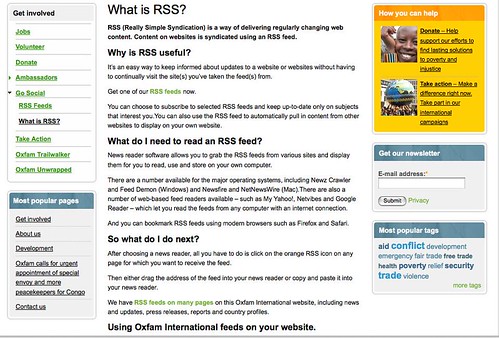
Next to the RSS feeds is a link to "What's RSS?" When you click on it, you see this page:


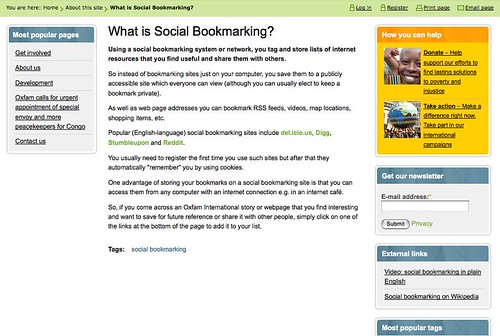
Next to the links for del.icio.us, Facebook, etc. there is a link to "What are These?" When you click on it, you see a page that explains social bookmarking:


This page could use a little more fleshing out to explain how each service works.

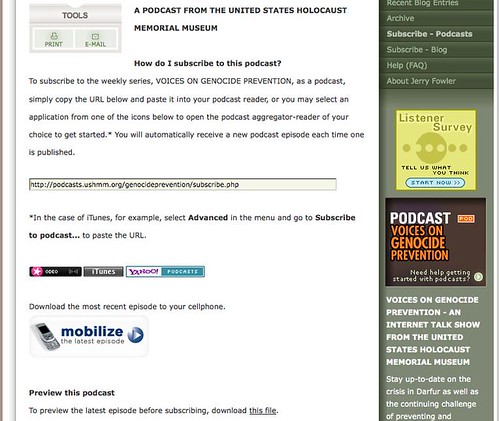
Another good example of a nonprofit helping folks learn how to use social web tools is the United States Holocaust Memorial Museum's explanation of how supporters can subscribe to their Voices on Genocide Prevention podcast:


Although more people have heard the words blog, podcast, Facebook, MySpace, YouTube, etc., don't assume that they actually know how to use them. Don't forget to help them out, so they can help you (:


Thursday, October 30, 2008

Join the 29-Day Giving Challenge with Me Oct 30-Thanksgiving

As I mentioned last week in my interview with 29-Day Giving Challenge founder, Cami Walker, I'm starting my second round of the 29-Day Giving Challenge today, and ending on American Thanksgiving.

During the 29-Day Giving Challenge, you give away one thing every day for 29 days. I wrote about my experience doing the Challenge last spring in my post 29-Day Giving Challenge Takeaway: Compassion is Hardest to Give. I'm interested to see what the experience will be like this time.

You can find out more information at www.29gifts.org, including a free PDF of a 29-Day Giving Calendar you can use to record what you give.

Lemme know if you decide to participate!


Monday, October 27, 2008

Ask Britt: 5 Tips for Job Seekers

In a recent interview for a magazine I was asked,

"What tips do you have for the unemployed who are seeking full time employment?"

I thought I'd share my answer with you:

1. Get support either from a professional career counselor or coach, or a friend or group of friends.

If you work with a friend, or group of friends, agree to meet once a month (or more often if you have the time). In person is best, but if the people you want to work with are across the country, you can talk on the phone, or set up a Skype conference call. Each person gets a chance to talk about what they would like to work on until your next meeting, and ask for advice about challenges they are facing. It’s helpful to have a designated note-taker to write down what each person says they are going to do so that at the next meeting they are held accountable.

2. Break everything down into small steps.

Part of the fear people experience when looking for new work comes from being overwhelmed. For example, if, “Update my resume,” has been on your to-do list forever, break it down into small steps you can take each day so it feels easier to achieve, like this:

a. Find and read my old resume.
b. Do research for 30-60 minutes about the best way to format my resume for the kind of job I'm looking for.
c. Add new experience to my resume (don’t worry about the format or language yet).
d. Spend 30-60 minutes on the format and language.
e. Show the resume to my friend or coach.
f. Incorporate my friend or coach’s comments.
g. Put it away for a couple days.
f. Give it a final edit.
g. Start sending it out!

3. Make a schedule. When you don’t have to be anywhere at a particular time, it’s easy for the day to fly by. Decide how much time you are going to spend each day looking for work, and stick to it. If you have a laptop, it may be less distracting to have your job search time at a café, or the library so that when you come home you don’t feel guilty relaxing.

4. Network, network, network. The best way to get your resume to the top of the pile is to know someone at the place you want to work. Make a quick bullet list of the qualities of your ideal job. Email it out to your friends. Memorize it to tell people at parties who ask, “What do you do?” Create LinkedIn and Facebook profiles, and add friends colleagues as connections. Search the web, and on sites like meetup.com, and upcoming.com for networking events in the fields you are interested in. If you want to work at a nonprofit, check out their volunteer opportunities, or search on VolunteerMatch.

5. Make a fun to-do list. It may feel like you’ll never get another job, but you will, and when you do, you’ll be kicking yourself for not taking full advantage of the free time you had. Make a list of all of the things you’ve wanted to do, but haven’t had the time. Once you’ve completed your scheduled job search time for the day, make time to have fun!

*******************************************************************************

I've been helping people find work they love for 10+ years. You can learn more about my work at brittbravo.com. Email me your questions (please keep it to 50 words) about the do-good, or artistic work you are doing, or want to do, to britt@brittbravo.com. Title your email, "Ask Britt: your question topic." I won't post your name, but I will post your question with my answer, so keep that in mind as you write if you don't want details in your question to identify you.

Photo Credit: Photo of me answering your questions (: taken by my hubs.


Friday, October 24, 2008

Change.org Launches Blog Network, And They're Hiring

When Change.org started less than two years ago, its main focus was to be a social network where nonprofits and their supporters could connect and take action. In early October, the network re-launched as a social action blog network.

O
verseen by Managing Editor, Josh Levy, the network features 12 blogs covering a variety of causes:

Each blog's landing page allows members to join the Cause, take action, and connect with related nonprofits. For example, the Actions section of the Stop Genocide blog (screenshot above) has a link to Call 1-800-Genocide. Its Nonprofit section has a list of nonprofits related to stopping genocide, and a leaderboard of Change.org members who are raising money for the cause. As of this writing, the Stop Genocide Cause has 1,793 members, has benefited from 1,270 actions and raised $2,280. Like other social networks, Change.org members can also "friend" and email each other.

Change.org plans to add more Cause topics, and is hiring bloggers to write and build community around the issues of Global Poverty, Universal Health Care, Microfinance, Human Trafficking, Public Education, Poverty In America, Global Health, Water Sustainability, Curing Cancer, Sustainable Agriculture, Racism, and Mental Health.

Here's a sampling of what other bloggers are saying about the new Change.org:
"I can see Change.org becoming a social action site for the more mature crowd who want knowledge before they get involved, and who want to do more than passively sponsor causes through corporate donor widgets. . . . In the interest of moving social action from an online only activity to an offline one, effecting real world change, this lets you tap into a much wider network to find support for your activities and ideas."
--Change.org Launches Social Action Blog Network by Leslie Poston on Mashable

"I really like the way the people behind this site provide a centralized space for learning about various causes and then – perhaps more importantly – provide readers with a way to take action. As a busy mom, I have many good intentions about doing things to support the causes I’m passionate about. But, to be perfectly honest, I need an easy way to take action. At this point in my life, I just don’t have the time to volunteer, and I certainly don’t have a lot of expendable cash. Change.org seems to offer a solution that meets my needs."
--Blogging to Change the World by Jamie Lee on BabyCenter: MOMformation

"If Change.org is going to grow as an online community and a web portal for people searching to get involved in issues and causes, it's going to have to struggle with the same problem we all have when it comes to social change. Beyond giving busy people a five minute action like making a donation or signing a petition or forwarding a message, how do we get salient numbers of people organized in support of actions that have lasting, systemic effects?"
-- Changes at Change.org: A Media Hub for Social Action by Micah Sifry on techPresident
Have you tried the new Change.org? Whaddya think? You can follow Change.org as it develops on Blog for Change(.org)


Thursday, October 23, 2008

Webinar Presentation Tips for Nonprofits and Other Folks

I'm teaching my first webinar for a client in a couple weeks. Wahoo! I've been doing some research on how to present a successful webinar, and thought I'd share what I've learned.

For folks who are unfamiliar with webinars, they are online classes where participants watch the speaker's presentation on the web, while listening to it via their phone. NTEN, Idealware, and TechSoup host webinars that will answer many of your burning nonprofit and technology questions!

I'd like to see more nonprofits using webinars to engage supporters and potential supporters. They could be a fun way to do trainings for volunteers, fundraiser table captains, house party hosts, and concerned citizens who want to learn more about the issues you are working on.

Below are the webinar presenting tips I found. They aren't that different than best practices for face-to-face presenting . . . I hope you'll share your tips too.

1. Write the script, then create the PowerPoint. Check out Seth Godin's post Really Bad Powerpoint, Guy Kawasaki's the 10/20/30 Rule of PowerPoint, and Presentation Zen's What is good PowerPoint Design? for ideas.

2. Run a practice webinar to work out any technical glitches.

3. Arrive early so you can welcome folks. Your first slide should let people know that the meeting will be starting shortly.

4. Review guidelines, like how people can participate (i.e. chat, raise hands), and how to mute phones.

5. Build rapport by posting your photo while you introduce yourself. If it is a small group, encourage people to make short introductions.

6. Get everyone's attention in the beginning: tell a story, provide a statistic, read a quote, or show a shocking image.

7. Provide a clear outline of everything you are going to cover, and what your learning objectives are.

8. Keep the session interactive by providing places for people to ask and answer questions throughout the presentation whether by virtually raising their hands, chatting online, or having a discussion over the phone.

9. If you know them, use people's names, and include them in examples when appropriate.

10. Share information in short segments.

11. Speak slowly and clearly. Pause frequently to allow people time to absorb the information.

12. Leave plenty of time for questions at the end.

Sources:
Tips: Writing and Planning a Webinar on Quinn Creative
Webinar Hosting: 10 Tips on Hosting a Successful Webinar on Charlwood eMarketing
Professional Development and Corporate Training: The Webinar Weakness on E-Learning Queen.
What To Cover When You Teach A Webinar? on Online Webinars
Seven and Seven: Tips for Running Effective Webinars on Chief Marketer
Running Effective Online Trainings on TechSoup

Flickr photo credit: They just asked about twitter . . . uploaded by Beth Kanter
Cross-posted from NetSquared.

Be Bold Podcast: Create a Career with Impact, Episode #2

As I mentioned last week, I've started hosting a new podcast produced by Echoing Green, the Be Bold Podcast. This week's show features a discussion of two career related questions with Lara Galinsky, author of Be Bold: Create A Career with Impact.

This week's question are:

1. How does someone like me with problem solving skills, passion, intelligence, experience and judgement, but with a resume not steeped in social issues work, find their niche in making an impact?

I want to help people become the heroes of their own stories—I think storytelling and mythmaking is the missing link in getting people to connect deeply to the causes we all know need attention – and I know how to do that-but how do I make a career out of it?


2. a. I feel guilty for wanting to work in social impact-my main motive is that I find social impact work fascinating and fun, and helping others—isn’t really a huge priority in comparison. Is it wrong that I’m not totally altruistic?


b. How can I combine being creative (or creative industries in general) with social impact?

You can listen to the Be Bold podcast online, or subscribe via iTunes. You can send in your questions to be answered on the Be Bold Podcast to bebold@echoinggreen.org

Also, be sure to also check out the Be Bold Resources page, and the New York Times' Social Impact Career Center, created in partnership with Echoing Green.


Wednesday, October 22, 2008

29-Day Giving Challenge: An Interview with Cami Walker


"What I notice is that the people who are taking part in this, what is common amongst us all, is that we all count our blessings. We practice gratitude. We feel like our lives are full no matter what we have."
-Cami Walker, Founder, 29 Day Giving Challenge

The 29 Day Giving Challenge is a global giving movement where participants give away one thing each day for 29 days. I wrote about my experience with the Giving Challenge last spring in the post, 29 Day Giving Challenge Takeaway: Compassion is Hardest to Give. I'll be starting the challenge again on October 30, 2008 so that the 29th day of my challenge will be on November 27, 2008, American Thanksgiving. I hope you'll join me! You can download a 29 Day Giving Calendar and gift cards on the 29 Day Giving Challenge social network.

Below is an edited transcript of an interview from October 11, 2008 with Cami Walker, the founder of the 29-Day Giving Challenge, which you can also listen to on the Big Vision Podcast. In the interview, Cami mentions that she is writing a book about the 29 Day Giving Challenge. She is looking for personal stories about the healing power of giving from people who have completed the Challenge. The deadline to submit your story is November 29, 2008.

What is the 29-Day Giving Challenge?

The 29-Day Giving Challenge is actually an odd little creative experiment that I started about seven months ago, almost exactly. It started with me. I was in a very dark place struggling with a very serious health condition. I have multiple sclerosis, and my life was in a very awful place. I was broke. My business hadn't made any money in months. I was too sick to work. I'd been in the hospital five times in three months, or something like that. My marriage was under a lot of stress because of all of this.

I work with a medicine woman from Oakland. Her name is Mbali Creazzo. I called her to complain, and she gave me a prescription that day to give away 29 gifts in 29 days, as a way of getting out of myself. I thought it was a really crazy idea. I jotted down in my journal, "Give away 29 things in 29 days," and then put the journal away and promptly ignored it.

About a month later things were even worse, and I was in an even worse place. I guess I'd gotten in enough pain that I was willing to try anything [laughter]. I happened to open the journal. I was awake all night one night, and it was like three a.m. I picked up my journal to write, and opened it right to that page that said to give away 29 things in 29 days.

I thought, well, I don't think it's going to hurt me, and maybe it will help. So, I decided in that moment that I was going to go ahead and do it. I gave my first gift that morning, which was just a supportive phone call to another friend who has MS. That same morning, an amazing string of events happened that showed me that maybe this really could help.

So, I decided to go ahead and do it. By the midpoint, around day 13, my life was so much better, and I was so inspired that I decided to throw up a website and send out an email to some of my friends, about 30 people, and said, "Hey, I've been doing this interesting thing where you give away 29 gifts in 29 days, and it's really helping me. You should try it."

A week later 120 people had signed up. And now, it's about seven months later, and we have over 2,500 members on the website [laughs]. So, yeah, that's how this all started.

What are the things that people can give?

If you decide to commit to the 29-Day Giving Challenge, you can give anything to anyone. The gifts can be material things. If it's a material thing, we like to encourage you to re-gift items that you own. So, go through your book collection and take books to the library or a used book store, or pass them on to someone on the street, or whatever. Or, go through your CD collection, or your clothes. A lot of people have gone through their kitchens, and made up snack packs. People will make 29 snack packs and then take them out and give them to people who are hungry, or to food shelters, or whatever.

The gifts can also be non-material things like kind words, or doing something nice for someone, or volunteering some time. I'm a marketing consultant, so a lot of times what I've done is give away small amounts of free consulting time to people who couldn't afford to pay me what I charge.

So really, it's any kind of gift to anyone. The gift can go to someone that you know. It can go to a stranger. Sometimes people even sit down and do meditations, and send out positive energy to the world.

What is the favorite gift that you have given?

There are a lot of gifts that I've enjoyed. I'm really enjoying the Flower Power Gives, though. That started with me, as well. I live in Los Angeles and when I was wrapping up my third cycle (I'm actually three or four days into my eighth cycle of 29 days of giving), I decided to go buy four dozen roses. I went out to a really busy street corner. There was a Whole Foods parking lot there and a bunch of bus stops nearby. I made a few loops around that area and gave away all these roses to strangers. That was awesome.

That has kind of become a signature give through 29 Gifts, because we had a few other members who individually then went out [and did it]. One woman went and picked wild daisies. We have these little 29 Gift cards that people would tie onto the flowers, and she actually made a couple vases full of those, and took them into a local coffee shop. They were free for anyone to take.

Now there are organized events happening locally. People have organized group gives in Atlanta, Houston, a couple times in Los Angeles, and it will happen tomorrow in San Francisco, that as a group we get together and give away roses to strangers.

How has it changed you ? What's your favorite gift that you've been given from the 29-Day Giving Challenge?

Well, I have to say, selfishly, that the favorite gift I've been given is a book deal [laughs] to write the 29 Gifts book.

Though, I've had such amazing changes happen for myself. You know, when I started doing this, I literally couldn't walk. I was very, very ill. And, by the 13th day of giving, my first cycle, I was actually back on my feet and walking without a cane some days. By the 29th day, I really was walking pretty much unassisted. I mean, every once in a while now I still have to break out the cane if I'm having a really rough day. The day that I stopped walking with the cane regularly was a very odd day. I had been out, my husband took me out to breakfast. And then a friend picked me up and we went for brunch, or lunch, and we stopped at this bookstore afterwards.

When I got home, I was getting ready to leave again that evening, and I couldn't find my cane. I realized that I had literally walked away from the cane at some point during that day. I don't remember when or how. I was like, "OK, something's working here." [laughs]

Getting my health back has been a huge gift, for sure. My relationship with my husband has dramatically improved because I'm not a resentful, miserable woman anymore that he doesn't want to wake up next to everyday. I've gotten closer with all of my family. A lot of wonderful things have happened in my life.

As you mentioned, there are over 2,500 people who've signed up on your site who have committed to do this, more than once sometimes. And they're also sharing stories. What are some of your favorite stories?

One of my favorites is a woman named Anne who, she's been doing this for a few months now as well, and I'm not sure at what point in the cycle this happened, but there was a gift that she gave that led to her reconciling with her brother who she hadn't seen in eight years. So, that's a really moving story.

There's a woman named Erin who is a community manager of our site. She helps manage the team of volunteers that run the site. In her first 29-day cycle, she built up to the 29th day. One of the things that was suggested by Mbali originally to me was to give one thing that you feel you can't live without, or give something that feels really scarce in your life.

For Erin, the one thing that she felt she couldn't live without, she doesn't have a lot of attachment to material things, was a breast pump that she had kept for many years. She'd loaned it out to a couple people, but she'd always really been careful about getting it back because it was the breast pump that she had used for her two babies who had died of heart defects.

This breast pump represented to her the one thing that she could do to help her babies stay strong and live as long as possible, feed them breast milk. This breast pump held a very deep emotional attachment for her. At a point during her first month - I think it was her first month - there was a friend of hers who wanted to borrow it. Apparently, the friend was notorious for not returning things, and she was really conflicted as to whether she wanted to do this, and actually said no.

Then she tried to sell it because she thought, "Well, it might be good to get rid of this. I've had it. It's probably good to let it go." She tried to sell it at yard sales, and on the websites, and no one would buy it. So, finally, she realized she was supposed to give it away to this woman. What unfolded, once she let go of that item, is a turn of events that happened in her family, and her family is in dramatically better circumstances now.

I think it's interesting what can happen for us if we let go of an item that we have a deep attachment to. I think we commonly don't realize that our energy can get bound up in an object, especially if you have an unhealthy emotional attachment to it.

Those are a couple of my favorite stories. There are over 3,500 stories that have been published on the site, so it's really hard to narrow it down to one favorite one. I could probably talk for hours about that.

I'm wondering, as we're in this crazy time of economic need, of so many people who feel like they don't have enough, and that they need things, and that they need to be given things, have you noticed any difference in the people who are signing up, or what people are giving, or the feelings? How has it affected the project, if at all?

Well, you know, we've actually had some really interesting discussions on our site. We have a forum on our site where there's been a good amount of discussion about abundance and scarcity. Mbali actually posted a very insightful response to Wall Street just a couple of weeks ago on the site.

You know, this is totally a personal belief that I'm going to spout off here [laughs]. I just want to add that disclaimer. I really do believe in the concept that our thoughts create our world.

Where I was at when I started this is I was in a deep place of "scarcity thinking" where I believed, I really did believe that my life was over, and I believed that I had nothing to offer anyone. I also believed that I was incapable of offering anything to anyone because I needed every ounce of my own energy for my own healing.

I was completely forgetting that healing actually happens through our interactions and connections with other people. It doesn't happen in a vacuum when you're locked up in a room for three months alone. That's really not a good place for any human being to be, honestly. [laughs] No matter how healthy you are, you should not be alone for three months.

I was in this place of lack, stuck in a place of lack. It was reflecting in every area of my life. Yes, it started from a physical, health-related issue, but it was reflected in my bank balance, it was reflected in the quality of my relationships, it was reflected everywhere.

One thing that Mbali said to me when I finally decided to do this, I called her later on that day or something, and she said, "I'm so happy you decided to commit to this because taking an action, giving something to another person, and taking an action of that sort, will immediately change the energy of your life. I teach that to my clients, but you know how we are, the things we teach we don't practice a lot.

It was really one of those moments where I felt myself reorganize on a cellular level where I really got something deep in my gut, and understood it.

The people who sign up for this, we all come from very different circumstances. There are people who need to use food shelters. There's actually a homeless couple who is taking part.

And then there are people, like me, who really aren't in desperate need of much. That's the reality. I like to convince myself sometimes that I need more, more, more. But that's not the truth. I'm fine. I have a roof over my head. I have a little bit of money in my bank account. I have a big balance on my credit card, but whatever, you know? [laughs]

What I notice is that the people who are taking part in this, what is common amongst us all, is that we all count our blessings. We practice gratitude. We feel like our lives are full no matter what we have.

In an economic crisis it is very easy for us to all trip into scarcity thinking, to begin to hoard things, and to be living in fear of losing a job, or losing our investments, or whatever, and that is the worst place we can go.

If you are spending all of your time focusing on losing things, you are going to lose things. That is the reality, but if you are spending your time reflecting on everything you have to offer, you are going to be attracting more of what you have to offer.

You mentioned you have done this eight times, and there are other people who have done it multiple times, do you think you will ever stop?

Well, I don't like to ever think I know what the future holds [laughs]. I find if I think I know what the future holds, I am in trouble usually! [laughs] Right now I have a hard time imagining removing this. This is a part of my daily spiritual practice now, in a mindful way, offering something to another human being. It is hard for me to imagine my abandoning that practice, but I have abandoned parts of my spiritual practice before for periods of time. Sometimes I come back to them, and sometimes I don't. I'm not sure if I can really answer that firmly. Right now I think I will be doing this for quite some time.

When does it stop being a challenge and become, like you said, a practice, or a lifestyle. Does it ever stop being a 29 day project, and become something that is more incorporated?

People often ask, "Why 29 days. Why not 30? Why not . . .?" whatever, and the truthful answer to that is, I don't know why the 29 days, and Mbali doesn't know.

This is a tradition that was passed on to her by a teacher, and when I asked her, "Why 29 days?" she said, "That is what my teacher told me, and that is what I'm telling you," which is the answer I get from my yoga teachers a lot. "Why do you teach it this way?" "Because that is how my teacher taught me."

I didn't really question the 29 days. My assumption, because this comes from an indigenous African medicine culture, is that it is related to the moon cycle. The reason that I actually gravitated towards the number 29, and I appreciate it and like it, is because from a scientific perspective, we generate new neural paths, (it depends on whose data you read), but anywhere from 21-28 days is what it takes us to generate a new neural path, so if you actually practice something every day for 29 days, you've begun to ground a new habit, a new way of being into your body, and your mind. I really like the practice of doing something every day for 29-30 days for that reason.

For me, it really was after that first 29 day cycle where it was just part of my day, and I didn't want to stop. I think that has been a common experience for people on the web site. Whether they choose to stay an active member of the community online or not, most people on their 29th day when they post say, "I am going to keep doing this. It has really helped me. It has changed my life in a lot of ways, and I am going to keep doing this everyday." I think it's probably different for everybody, where that switch happens, but for me it happened pretty quickly.

How can people join the Challenge, and how can they participate? What is your web site?

The URL is www.29gifts.org. When you get to the home page you will see that there are buttons that say, "Sign up" and buttons, that say "Join us." You can click any one of those buttons. We ask you a few, very simple questions like, "Why are you choosing to give? What would you most like to receive?" You will be a member of the community within a minute, if you take the time to answer those questions.

Is there anything else that you want folks to know about the 29 Day Giving Challenge?

Well, one thing that I like to say about this is that it is founded on a personal belief of mine that we are all creative beings, and that creative expression is truly essential to our health, our well-being, our sense of purpose, and our happiness in the world. I really do encourage people to take part in the community. It is OK if you don't want to, if you fill out a profile, and do your giving privately, that is completely acceptable.

But, I do see that the people who seem to really get a lot out of this, and really experience dramatic change in their own life are the people who are active on the discussion forum, who are active in their blog and actively post artwork in the community gallery.

Lately we have had people do video blogging and put shorts up, or a couple people have written songs, and sent them to me to put into the community music player. Create something to tell us what kind of impact this has had for you, and share it with the community because those stories and artwork that people are sharing are what are inspiring people to sign up, and keep this movement growing.

Together I really do feel we are making progress at our collective mission of reviving the giving spirit in the world, and I hope you will decide to join us, and be an active participant.

******************************************************************
Here are a few bloggers' reflections on their experience taking the Challenge
The Painting Project for the 29-Day Giving Challenge is Complete!!! by Spirit River Studio.
My 29 Day Giving Challenge: An Update by Morningside Mom
29 Day Giving Challenge by The Life of a Soon to Be Mommy!

Cross-posted from BlogHer


Tuesday, October 21, 2008

Ask Your Nonprofit Blog & Podcast Questions At My NTEN Office Hours

This fall I've been volunteering as an "expert" for The Nonprofit Technology Network (NTEN)'s office hours. Each week I chat online with whomever shows up about nonprofit blogging and podcasting.

Most weeks my hours have been on Thursdays from 9-10 AM PT. You can check the NTEN office hours calendar to see when I'm available, as well as look through all of the other folks who are available to give you advice about your nonprofit technology questions like Michelle Murrain, Sue Cline, Sarah Davies, and many more.

I'll be there this week on Thursday, October 23rd from 9-10 AM PT. You don't need to register beforehand, just go to nten.org/officehours/communications between 9-10 AM PT on Thursday. You'll see a Meebo chat box where you can type in your question. Meebo is super easy to use, but if you get confused, here's a link with more information abut How to Use Meebo.

Hope to see you there!


nptech

Do Something Now Challenge: Gen Y + Mobile + Volunteering + Community

The Millennials, or Generation Y, want to make a difference. As Tactical Philanthropy's post, Millennials as Social Citizens, observes,
"USA Today reports that they volunteer more than any previous generation, and the Wall Street Journal reports today that corporations are finding that one of the best ways to attract them as employees is to offer them paid time off to volunteer."
They also like to stay connected to their community. As GigaOM's post, Go Mobile Young Millennials, Go Mobile, notes,
"[A] report from In-Stat points out that millennials, the generation aged 8 to 27, use their mobile phones to access their social networks wherever they are."
When you combine young people, a desire to make a difference, cell phones, and community you have the elements of the Do Something Challenge. For almost two months, Do Something, an organization that helps young people make a difference, has been hosting the Do Something Challenge. To participate in the Challenge, young people recruit friends from their community to receive volunteer opportunities via text on their cell phone.

Participants who register 50 or more people will receive prizes based on the number of people they recruit.
  • 50 Recruits: 20 SWAG Sets with Do Something pens, folders and notebooks.
  • 100 Recruits: 20 SWAG Sets and 20 Do Something reusable ecobags.
  • 250 Recruits: 20 SWAG Sets, 20 ecobags, 20 t-shirts, and a $100 pizza party.
  • 1000 Recruits: 20 SWAG Sets, 20 ecobags, 20 t-shirts, a $100 pizza party, and 2 plane tickets to New York City for Do Something Boot Camp.
If you, or someone you know wants to take the Challenge, the deadline is November 1st. For more information, go to www.dosomething.org/challenge

Hat tip to Creativity in Public Relations for their post Volunteering Via Mobile: Dialing Up New Ways To Help.

Cross-posted from The Extraordinaries blog.