Showing posts sorted by relevance for query resolution. Sort by date Show all posts

Thursday, December 31, 2009

9 Have Fun Do Good Reflection Questions for Your New Year


One of my favorite things about this time of year is reflecting and planning. I've been enjoying other bloggers' reflection and planning posts like:
I'm also looking forward to listening to the mp3 of Kimberly Wilson's New Year, New You tranquility du jour teleclass on January 4th.

Below are 9 Have Fun Do Good New Year Reflection Questions that I hope you'll find helpful as you think about your New Year's resolutions, goals, intentions, wishes and dreams.
  1. What does having fun mean to you?
  2. What does doing good mean to you?
  3. How did you have fun in 2009?
  4. How did you do good in 2009?
  5. How did you have fun and do good in 2009?
  6. How do you want to have fun in 2010?
  7. How do you want to do good in 2010?
  8. How do you want to have fun and do good in 2010?
  9. What is the one have fun do good 2010 resolution you are the most excited to keep?
The have fun do good resolution I am the most excited to keep is about gift giving:
In 2010, I am going to make gifts, give gifts of time together, or buy gifts from local businesses, or creative entrepreneurs.
What is your have fun do good 2010 resolution?


Bookmark and Share


Friday, January 23, 2009

What Are Your 2009 Have Fun Do Good Resolutions?


I think it's wise to make your New Year's Resolutions a few weeks into January. When you make them on January 1st, you're feeling rested and relaxed after time off, and may have unrealistic expectations of what you can acheive. Waiting a few weeks until your "real life" is in full swing can help you craft more realistic goals.

My six 2008 Activist Resolutions went so-so:

I did . . .
I didn't . . .
  • Increase the number of people of color I interviewed for the Big Vision Podcast. It stayed about the same.

  • Donate 5% of my income. It was closer to 3%.

  • Have more fun while doing good, which gives me pause. Although I enjoyed a lot of the things I did last year, I still felt like I was trying to do too much at one time--which is exhausting, and stressful.
Clearly, I need to do less. In that spirit, I'm making only three 2009 Have Fun Do Good Resolutions
  • Write each month to the woman from Sudan who I am sponsoring through Women for Women International.

  • Participate in the 2009 Indie Resolution Challenge sponsored by my local paper, The East Bay Express. To get involved, I emailed my name and address to Indie@EastBayExpress.com. In February, they'll mail me an Indie Resolution Journal and information about how to find local businesses.

    Each month they'll have a theme (i.e. February - celebrate local musicians; March - local, socially responsible investing). I'm supposed to write at least one journal entry each month about how I supported local businesses. At the end of the year, I mail it back to them for a chance to win $5800 in local gift certificates.

    They chose $5800 because according to The Express, "Fifty-eight percent more of your money stays in the community when spent at local, independent businesses rather than out-of-town chains."

  • Volunteer in Oakland outside of my home office, and away from my computer. I'm hoping to work with the Reading Partners program at a local public elementary school. Adult volunteers read once a week, one-on-one with two students for 30 minutes each.
What are your Have Fun Do Good resolutions?

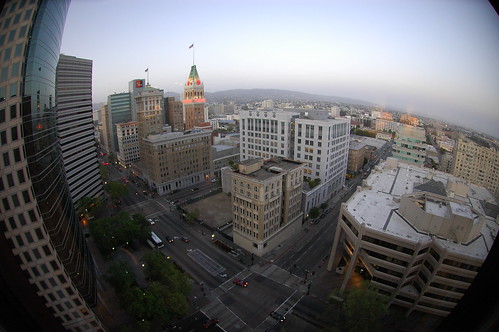
Flickr photo credit: Downtown Oakland 2 uploaded by ChrisDag.

Bookmark and Share


Friday, December 28, 2007

What Are Your 2008 Activist Resolutions?

"[S]top thinking about how crazy the times are, and start thinking about what the crazy times demand."--Seth Godin

A couple weeks ago blogger Latoya Peterson posted her 2008 Activist Resolutions on Racialicious. Some of her resolutions were to reconnect with her city council members, get more involved with youth outreach through the arts, and "stop saying 'Africa.' Africa is not a country. It is a continent."

Many of Latoya's readers shared their activist resolutions in the post's comments. Atlasien of Upside-Down Adoption said she was going to become involved in a local organization for immigrant rights. Elizabeth said she would like to write her representatives and local newspaper more, like Vegankid does.

B! of A Daughter's Geography was inspired by Latoya's post and wrote her own Sunday Shine * {Activist Resolutions}. Her resolutions include eating local organic food, teaching her students about healthier eating options, and volunteering at a community garden.

I really liked this idea so thought I'd post my own:

1. Continue reading and learning about why genocide happens and what I can do to encourage the United States to be a part of the solution. I recently finished reading A Problem from Hell: America and the Age of Genocide by Samantha Power. It was probably one of the best books I've read and definitely helped me to better understand the issue, and America's policies and history around it. Power is on my Big Vision Podcast dream interview wish list, if anyone knows her and can provide me with an introduction.

2. Interview more activists/visionaries of color for the Big Vision Podcast. Last year I interviewed 12 people for the Big Vision Podcast and 4 of them were people of color. I'd like to up that number to 6. Zainab Salbi, the founder of Women for Women International is also on my dream interview wish list, if you know her.

3. Carry at least one cloth shopping bag with me at all times. My aunt gave me an Envirosax for Christmas that should make keeping that resolution easy. The same company also sells a shower timer that I'd like to start using too.

4. Write to Jacinta Onoro, the woman I am sponsoring through Women for Women International, each month.

5. Donate 5 % of my income. (Check out this interesting Giving Calculator).

6. Have more fun while doing good. I worked a little too hard and did a little too much this year (evidenced by the fact that I am in bed with a cold right now). I need to be a bit more balanced in the fun department in 2008, spend more time with my family and friends, read silly as well as serious stuff, and take time to enjoy all the things that are going well in my life and in our world.

What are your 2008 Activist Resolutions?


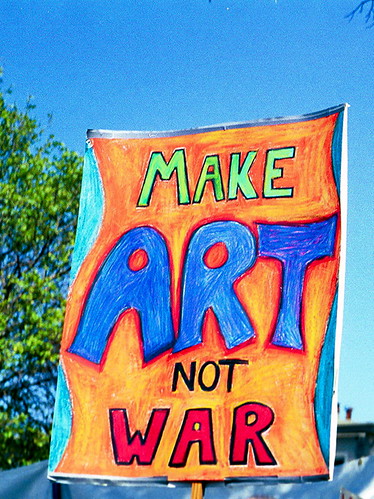
Photo of sign from 2003 Iraq war protest by me.

Sunday, November 13, 2011

Dancing for Peace: Big Vision Podcast with Sara Potler

"We had a blast!  These kids over the course of the next 18 months did not really fully comprehend that they were learning basic social, emotional, and civic competencies because they were moving and dancing the entire time." -- Sara Potler

Sara Potler is the Founder and CEO of Dance 4 Peace.  Dance 4 Peace is a conflict resolution, and civic education program that promotes empathy, understanding, mediation skills, anger management, and emotional and civic engagement through dance in youth around the world.  

Dance 4 Peace began in Bogotá, Colombia as part of Sara's Fulbright Scholarship project in 2007. In conjunction with Aulas en Paz (Peaceable Classrooms), a multi-component pedagogical project designed to promote social and civic competencies and conflict resolution among primary-school students, Dance 4 Peace was designed, implemented, and evaluted in public schools in the outskirts of Bogotá.  Today, the program works in Washington, D.C., New York City, Colombia, the Philippines, and Nepal.

You can listen and subscribe to the Big Vision Podcast via iTunes, or on the player above.  If you have suggestions for people I should interview, please email me at britt AT brittbravo DOT com.  

*Show Notes*

Learn more about Sara and Dance 4 Peace:
Connect with me:
Music: "Mango Delight," by Kenya Masala.  Connect with Kenya through CD Baby and Source Consulting Group.

Bookmark and Share


Tuesday, January 02, 2007

New Year's Resolution: Virtual Volunteering


Did you write, "Volunteer" on your New Year's resolution list? One option you might want to consider is online or virtual volunteering.

Here's what some bloggers are saying about virtual volunteering:

Holly Ross, of the NTEN blog, points to a New York Times article about virtual volunteering, "Flexible Hours, Using Your PC and Never Leaving Home". The article mentions Sidelines National Support Network, a nonprofit that provides support to women with high-risk pregnancies via the Internet and phone. It also lists onlinevolunteer.org and VolunteerMatch as places to find virtual volunteer opportunities.

A Woman with a Common Name Tries to Live an Uncommon Life explains how she found virtual volunteer opportunities on VolunteerMatch.

Marie's post about virtual volunteering at The Drop recommends Translators Without Borders as a place that needs virtual translation volunteers, and links to Energize Inc.'s list of web sites where you can find virtual and in-person volunteer opportunities.

Beth Kanter points to a piece by Jayne Cravens about virtual volunteering. Jayne is an expert on virtual volunteering. Check out her Myths of Virtual Volunteering too.

VolunteerMatch logo taken from volunteermatch.org.


Wednesday, July 02, 2008

How Are Your 2008 Activist Resolutions Going?

At the end of December 2007, I posted about creating activist resolutions for the New Year based on Latoya Peterson's activist resolutions post on Racialicious.

We're half way through 2008, so I thought I'd share how mine are going, and check in on yours. My resolutions were to:

1. Continue reading and learning about why genocide happens, and what I can do to encourage the United States to be a part of the solution.

What I've done:
Read What is the What by Dave Eggers.
Read Darfur Diaries by Aisha Bain, Jen Marlowe and Adam Shapiro.
Watched Darfur Now.
Interviewed Janessa Goldbeck of the Genocide Intervention Network.

Challenge for the rest of 2008:
I'm feeling a bit discouraged about what feels like a lack of progress in the situation. Need to figure out how to get energized to take action around it.

2. Interview more activists/visionaries of color for the Big Vision Podcast.

What I've done:
I've done so-so with this so far. This year I've interviewed Christina Arnold of Prevent Human Trafficking, Cristi Hegranes of the Press Institute for Women in the Developing World, Kavita Ramdas of the Global Fund for Women, Anisha Desai of the Women of Color Resource Center, Janessa Goldbeck of Genocide Intervention Network, and Ari Derfel of Save Your Trash.

Challenge for rest of 2008:
I only have 6 more interviews for 2008. I do one per month. I would like to do 3 interviews with activists/visionaries of color who are having fun and doing good. Feel free to send me suggestions.

3. Carry at least one cloth shopping bag with me at all times.

What I've done:
This has been easy. I take my Envirosax most places with me.

Challenge for 2008:
I've gotten paper bags a few times because otherwise we don't have anything to put our recycling in (ironic). Any suggestions for an alternative container to put your paper recycling in? I don't think you can just throw all of your individual papers/newspapers/magazines into the recycling bin they pick up, can you? Seems kinda messy.

4. Write to the woman I am sponsoring through Women for Women International, each month.

What I've done:
Written her a letter each month.

Challenge for rest of 2008
She hasn't written back. When you sign up to be a Women for Women International sponsor, they make it clear that some of the women are experiencing circumstances that make it difficult for them to write. I totally understand that, but it is getting harder to get motivated each month when I'm writing into the void.

5. Donate 5 % of my income.

What I've done:
Donated 3%

Challenge for rest of 2008:
Step it up to 5%

6. Have more fun while doing good.

What I've done:
Started doing yoga again (I'm a certified instructor and used to do it every day for years). Made some changes in my work life to give me more space for creative projects and down time.

Challenge for rest of 2008:
As I've let go of some things, I've noticed that the space fills up again with new opportunities. Gotta be particular about what I say yes to.

How are your 2008 Activist Resolutions going? Here are what some people wrote in the comments of the original post on Have Fun * Do Good and BlogHer that they were going to do :

Green LA Girl said she would pack her own chopsticks.

Cooper of An Unforgivable Hell on Earth said she would continue supporting two women through Women for Women International, volunteer at a women's shelter, start grad school to study public policy and interntional relations, continue her blog about Darfur, and participate in local activism around Darfur.

Michael of All Day Buffet said he would like to, "inspire more young people that wouldn't normally act to do something that changes the world!"

Amy of Shaping Youth wrote, "I hereby 'resolve' to mobilize youth by activating core caring in various forms of content creation. We'll help empower kids in upbeat, social/media forms of fun, to make a difference in communities online and off."

Ryan of Riches for Good wrote, "My resolution isn't specific to 2008, but I made it this year: My goal is to help at least 1 million people out of extreme poverty, or $1-per-day poverty, during my lifetime."

Photo by me.


Tuesday, December 18, 2007

Training Social Changemakers: An Interview with Andre Carothers of the Rockwood Leadership Program

"These skills, which one sees in action around the country with certain key individuals who seem to be able to bridge gaps between organizations and issue areas, we can teach them. They are teachable. And I think teaching them is probably the most important thing we can do right now."
The Rockwood Leadership Program specializes in delivering the best practices and methodologies in leadership development to the nonprofit community. In my most recent interview for the Big Vision Podcast, I talked with Andre Carothers, the Executive Director and Co-founder of the Rockwood Leadership Program about the Program's work, and nonprofit leadership trends. You can read a transcript of the interview below.

Andre Carothers: Hi, I am Andre Carothers, I am the Executive Director of the Rockwood Leadership Program. We are a national nonprofit that trains advocacy professionals, people working for nonprofits full-time, in the fine arts of collaboration, leadership, listening, speaking, conflict resolution, and collaboration across organizational boundaries. We teach all those skills and practices that one associates with getting a job done, and also in a political setting, joining forces with allies to generate a political goal that we are all looking for.

We have been doing this work for six years now, and we started with an open training for 20 friends of mine from Washington D.C., where I used to work, and one trainer. The training was so well received that we launched an organization in 2000, and since then have recruited and trained more than 1700 people.

We've got four programs going simultaneously, and we have a four-day workshop called The Art of Leadership. We have Fellowships in issue areas where we bring together leaders working on specific issues, such as media policy and justice, LGBT policy and justice, electoral reform and racial justice, and we convene them over a year or more, and build a learning community that serves their work. It has been a terrific run and we are growing rapidly.

I think the need that we are responding to with Rockwood is that people really want to learn how to get along professionally. They want to learn how to build strong partnerships with people, and we have got literally hundreds of thousands of small nonprofits, many of whom are trying to do the same thing. I think the key for us to create real social change is aligning groups and individuals in a common direction.

Britt Bravo: What are the skills and qualities a social change leader needs today, and how do they learn those skills from Rockwood?

AC: Statistics and studies show that the greatest source of project failure, I define project failure as any initiative that falls flat, is the lack of ability of the leader or leaders to align and inspire their team in a common direction. We often associate that leadership quality, the ability to create a team and attract and maintain very good people in an organization, as some sort of magic. You know, you are born a leader, or "they've just got what it takes," etc. It turns out, that most of these skills are teachable.

A lot of the curriculum that we have created over the last few years is drawn from programs in the private sector, senior leaders in Fortune 500 companies, and it's drawn from grassroots organizing traditions and, in some cases, from personal transformation and contemplative discipline.

We tried to create a new definition of leadership on the progressive end of the spectrum, one that focuses on people's humanity, connecting with people on a personal level, and being very focused on very specific goals and objectives. These skills, which one sees in action around the country with certain key individuals who seem to be able to bridge gaps between organizations and issue areas, we can teach them. They are teachable. And I think teaching them is probably the most important thing we can do right now.

BB: What is an example of a piece of Rockwood curriculum that would teach one of those skills?

AC: We have developed about 20 days of curriculum now, and we can mix and match those 20 days in a variety of ways. In the basic four-day workshop, which most of our alumni (roughly 1400 people around the country) have been through, the second afternoon and the second evening and the third morning, are devoted to a section we call Partnership.

Partnership is about, first of all, learning how you show up for other people. Everyone that comes to the workshop comes with what is called a 360 Degree Survey, which is filled out anonymously by 10 or more of their colleagues, and basically describes how you are showing up across 15 parameters of leadership: "This person communicates well with the mission and purpose of the organization internally and externally," "This person moves toward and resolves conflict in the workplace successfully." Fifteen questions like that form the basis of the 360. The fifth thing we do in our four-day workshop is we present people with the survey and we give them time to integrate the information and build a leadership development plan based on it.

In the same Partnership section of the training, we do conflict resolution skills, we do negotiation skills, we teach people how to look at an issue from the other person's perspective, and we teach people how to manage difficult conversations so that they can get the outcome they need out of them. The feedback has been very positive.

BB: You have been doing this work for about seven years now, how have the leaders who participate in the program, the challenges that they face, and the skills that they need changed over time?

AC: Well it is interesting, one of the graduates emailed us the other day and said, "I thought that leadership was about cranking out my agenda, and what Rockwood did for me was pull back the other seven veils of what is required for me to get my social change aspirations made real in the world."

I think what he meant by that is that if we are to win some of the policy issues we are challenged by currently here in the beginning of the 21st century, there needs to be a new way of organizing ourselves. That new way is based significantly on what used to be called "people skills", or "soft skills." And what I say when people say, "Soft skills?" I say, "Yes, the hardest stuff you can do is the soft skills."

I think a lot of people listening to this will know that when they are trying to produce a result, and the partnerships they have with the people around them are strong, and people are clear, and they know how to manage themselves and others, the results are better.

When we started, we were really the only organization of this kind. Part of my motivation for getting this going was that I did a survey of the various programs out there for progressive advocacy leaders. There was nothing that focused on personal leadership skills. There was nothing that drew together that interesting combination of high-level private sector management skills with some of the key traditions of community organizing and contemplative discipline, and produced it in a package that allowed busy social change leaders to come get a complete experience over the course of four days, and get back to work.

What I have noticed in the intervening seven years is that there has been a lot more interest in this. Other organizations are coming up and producing programs that are great. The conversation on the progressive side of the aisle is much more about how do we build teams, how do we collaborate, how do we bridge the gaps between gradations of issue focus, and background, race and ethnicity.

The interesting thing about progressive people is that they are very interested in getting all voices to the table, they are comfortable with nuance, and they understand the complexity of issues, and that is a wonderful platform for governance. The second you are uncomfortable with nuance, like simple answers, and prefer the one note over the many notes, then you probably are a conservative Republican. Governance from this perspective is wonderful. Organizing is tougher.

It turns out that those characteristics that we value so much on the progressive end of the spectrum make organizing complicated. It is slower, it is more complex, it requires what we sometimes call "three-dimensional thinking," the willingness to focus your energy on the right point at the right time, and then make sure that you leave nothing out in your pursuit of a goal.

The skills we teach really allow this type of three-dimensional thinking. They allow people to remain true to the progressive ideal, which is thoughtful, nuanced and inclusive, and also organized toward results. I think that is the game. That is the 21st century organizing game.

BB: There are a number of reports that suggest that a whole generation of nonprofit leaders will be retiring soon and there aren't enough new leaders to replace them; what do you think nonprofits need to do to attract and keep more nonprofit leaders?

AC: It is a perfect example of where one has to think three dimensionally. There are actually three or four things going on simultaneously in the generational change. One is that young people are more interested in humane and collaborative workplaces, and so there is a stylistic difference between the baby-boomer activist generation, I am not sure what letter we are up to, X or Y, and the demand that the workplace be thoughtful and collaborative, that voices get on the table, and that people work well together. It is different than it used to be.

Secondly, there are a lot of people who have devoted their lives to social change for whom there is no social safety net. There is no organized way to support them in their 60s and 70s, and also to glean, and harvest, and make good on the lessons that they learn. That's a whole other piece of this puzzle.

Finally, I think the terrain around us has changed. There is a very different sensibility among the younger folks around where we need to focus our energy. I think there is a natural collaborative bent in younger folks for whom issues that used to divide people are no longer on the table for them. I think there are subtle differences, but important differences. And again, what I am noticing is that if we provide all the people who are focusing on this challenge, the generational leadership challenge, the personal and collaborative leadership skills to tackle it, anything is possible.

BB: What is one of your favorite Rockwood success stories?

AC: What is most satisfying about this work is to get, which we do very often, this random email over the transom from someone saying, "By the way, I just want you to know I did your workshop two years ago and since then..." and they list the things that have happened. That's a steady drumbeat from alumni.

We also did a survey of 40 alumni, from the last three years, and asked them what they wanted from us next, and the response was 100%, which is interesting for a survey. Those of you who do surveys know that anything above 30% or 40% is a good response. Universally the people said that the Rockwood Leadership Program, whichever one they happened to be in, was a pivotal moment in their professional lives. It made a difference for them.

At the nitty-gritty end of the spectrum, there have been collaborations, there have been specific projects, there have been gains in policy arenas that people credit to Rockwood. And the way they do that is they say, "I built a team around me, they were trained, we had a project to do, and I honestly believe that because of the training we had, we were able to produce the result quickly, and more effectively than we otherwise would have."

Some of your listeners may have gone to the U.S. Social Forum in Atlanta, and the steering committee for the Social Forum in Atlanta were the leaders of, I think, less than 12 organizations, maybe 10 organizations. As the organizing took place over the years, about seven of those 10 leaders did the Rockwood training, and the Chair of the Board said that it made a huge difference in their ability to pull off the Forum, the fact that these people were trained. Stories like that are the ones that keep us coming in in the morning.

BB: What are Rockwood's future goals and challenges?

AC: Well the interesting thing now is to take advantage of the fact of having 1700 alumni. People talk about network effects. What is the minimum requirement for creating a self-sustaining community? The number varies widely, depending on what you are up to, but we honestly believe that 1700 alumni, and adding 300 per year, is the tipping point at which we can start to build a self-sustaining network.

What that will require from us, of course, is a sophisticated web platform. We are really interested in building that in 2008. We have, and these numbers are rough, 250 alumni in Seattle, 500 in the Bay Area, 200 in Los Angeles, 300 or 400 in Washington D.C., and another 300 or so in New York City, and then the rest scattered around the country in Denver and Vancouver. In Boston, we probably have a couple of hundred.

These numbers mean that if we provide the right incentives for people, they will start to organize each other. What I mean by that is that we are, for many people, the go-to group for moving organizational agendas forward: how do I lead my team, how do I create a process where we can get aligned in the right direction, how do I resolve a difference between me and the members in my coalition. Once laid onto the Web, in terms of downloads, conversations, and all of the technologies that are available now, we know, based on our surveys of our alumni, that they will start to use it. They will start to share skills with each other, they will search for alumni within 20 miles of their zip code, etc. and they will begin to build a community around performance and results that doesn't exist yet; that is the one of the many things we are very interested in in 2008.

BB: What is the path that brought you to this work?

AC: I got my first job in nonprofits in 1984 in Washington D.C., and I got hired fresh out of college and worked for Greenpeace. In 1984, Greenpeace was a $400,000 company in the US, and over the course of my 13 years there, grew to, at its peak, we grossed $90 million in donations in the United States.

That growth curve was very interesting for a progressive nonprofit. We saw a lot of people get hired. We saw a lot of projects get birthed. We grew very quickly, and as many of you obviously know, Greenpeace has been historically one of the most effective environmental organizations in history. What I really saw while I was there, and I had a strong interest in, was, how does this happen? How does the team get built that produces these results? What are the minimum obligations of leadership that can create the results that the donors and the public want from us? How do we deliver that in a very effective, manageable package that people will come to, go back Monday morning, and feel like they have benefited greatly?

That was my original motivation. Being a slow learner, it took me 15 years from thinking about it, to actually starting a nonprofit. We roughly launched in 2000, and since then have grown from one trainer to 10 trainers, our training team is half people of color, our Board of Directors are a terrific bunch of people, and we are doing 10 to 20 events each year, and graduating close to 300 people annually.

BB: If people who are listening would like to get involved with Rockwood, what should they do?

AC: They should visit our website which is www.rockwoodleadership.org, and there is a little widget on there that you can click, and get our newsletter and our training announcements. We have a Facebook group called Rockwood that people talk to. We have a subgroup on LinkedIn called Rockwood that alumni have tagged themselves. There are a lot of ways in, and we do trainings all over the country, sliding scale based on your organization's income, so that the financial barriers are not great. And of course, we love talking to people, so if there are questions, comments and emails, we try to get back to you as soon as possible.


Friday, March 09, 2007

Interview with Jodie Van Horn of Freedom from Oil and Plug-in Bay Area

In September 2006, Marin County soft ordered 22 Plug-in Hybrids Electric Vehicles. In October the City of Berkeley soft ordered 40 plug-ins and in December the city of Alameda soft ordered 98. What's going on? The three Bay Area municipalities, along with Oakland and San Francisco (who haven't placed their orders yet) have all signed-on to be part of Plug-In Bay Area, an initiative to put more plug-in hybrid vehicles on the road.

I talked with Jodie Van Horn, a campaigner for Rainforest Action Network's Freedom From Oil campaign, and the coordinator for Plug-In Bay Area about the plug-in campaign in the Bay Area as well as the national Freedom from Oil Campaign. Below is a transcript from the interview, which you can also listen to on the Big Vision Podcast.

Jodie Van Horn: Plug-In Bay Area is a national grassroots effort to try to commercialize plug-in hybrid vehicles. We do that by pressuring automakers to start rolling these vehicles off of their assembly lines.

This was an initiative that began in the city of Austin, Texas with the municipally owned utility company, Austin Energy. They saw a need for a mode of ultra-efficient transportation that would plug in to a clean grid, and shift our fuel source off of gasoline, and provide us with an opportunity to find a cleaner, cheaper, domestic source of fuel and energy specifically for the transportation sector.

They began by setting a target of 50 U.S. cities. They were going to go out to those cities and try to form partnerships with the cities, to get the Mayors or the council members of those cities, at a policy level, to endorse the Plug-In Partner campaign, and then subsequently to get them to place a soft fleet order. A soft fleet order is an indication on the part of the municipality that were these vehicles to be commercially produced by the automakers, that municipality would buy "x" number of them the day they become available.

The desire of Austin Energy, and of this national initiative was to demonstrate that there is an existing market for a cleaner electric source of transportation, and that there is a recognition on the part of municipalities, businesses and consumers that technologies exist that will enable us to wean ourselves off of oil, and shift over to a new paradigm for our transportation needs.

From there, these efforts were springing up all over the country. They began with their approach of municipalities, mostly cities and counties. They were extremely successful in generating the support of politicians all over the country.

At a grassroots level, there had also been support for solution-based organizing around oil addiction, and around transportation, fermenting from some time. When this program sprang up, Rainforest Action Network, had been involved in campaigns surrounding the crushing of the EV1 a decade ago, which happened here in California -- with the car mandate -- many people have now seen Who Killed The Electric Car, and it goes into explaining that story quite well. So we had a history of organizing around transportation through our Jumpstart Ford campaign, which now has transitioned into our Freedom From Oil campaign.

With that history we recognized that plug-in hybrid vehicles are an immediate and viable solution to the issues that we have been trying to pressure automakers to acknowledge over the course of this campaign here at RAN. We picked this up and we dedicated a staff person to coordinate a local effort to get Bay Area cities and counties on board to support the national effort, and to contribute their soft fleet orders to the national demand for plug-in hybrids.

Britt Bravo: What are some things that are happening with plug-ins here in the Bay Area?

JVH: In the first six months we had five Bay Area partner municipalities; San Francisco, Berkeley, Oakland, Alameda and Marin County have all sign on. Out of those, Marin County, Alameda and Berkeley have all placed their soft fleet orders. We're also working with those cities on generating some demonstration projects.

It's a really exciting time. We've had announcements out of some of the automakers that there is a potential that they're building this platform for these plug-in hybrid vehicles to be produced. They haven't set any production dates, or indicated any numbers for their production. We don't want this to become a niche market. We see this as a potential future for transportation, or at least an immediate step to having ultra-efficient choices in vehicles for the public.

What we're trying to do is generate enough support to indicate that we need these announcements out of the auto industry to translate into something tangible. We're doing that by trying to bide our time until that promise comes, or until that commitment comes, by actually putting as many of these vehicles out on the road as possible and watching them operate in a real-world function; generating data on their emissions, reductions and fuel savings; educating the public about their potential to help us solve our oil addiction, and really getting them out into the hands of fleet operators; holding educational conferences and demo projects where people can rally behind this technology and continue to build that pressure on automakers so that they actually come through with some commitments on when and how many they're going to build.

BB: What is a plug-in hybrid?

JVN: A plug-in hybrid is essentially a conventional hybrid vehicle, like a Toyota Prius, with an additional battery pack that extends the range of the vehicle in all electric mode, and then adds a plug for overnight charging. It's a little bit like having an electric vehicle with a back-up gas tank. You can drive all electric for the extended range of your battery charge, and then when you reach the end of your battery capacity you have a backup engine in case you need to do long-distance driving. You always have the support of a back-up engine that ideally is a flexible fuel engine, which could be powered with bio-fuels or domestically grown cellulosic ethanol or some other more sustainable fuels than gasoline. It makes a much more sustainable vehicle and it doubles your fuel efficiency.

Additionally it decreases your carbon footprint and your tailpipe emissions significantly. Especially if you are plugging your vehicle into a clean grid, you're powering your car literally with renewable energy like wind or solar, that's coming directly from the grid and into your car, as opposed to filling your car with dirty gasoline, that's a foreign source of oil, and that has all of the implications of the chain of production of oil. It's much cheaper for the consumer; it's under a dollar a gallon to fuel your vehicle with electricity as opposed to gasoline, so there's a real consumer incentive to support this technology. Environment aside, from a consumers standpoint it makes a tremendous amount of sense.

BB: What's preventing this from happening? What is the argument against plug-in hybrids?

JVH: The primary argument coming out of the automakers at this time is I believe a bit of a cover-up for a larger problem, which is simply the inertia on the part of companies to change their model of business; to change their way of doing things. It would not require a huge investment on the part of automakers and what investment it incurs will be paid back over time in the savings from switching over to more highly efficient vehicles. This has been proven through studies that have been done of the current vehicles on the market and that demonstrate that even with existing technologies, we could improve the overall fuel efficiency of vehicle fleets to 40 miles per gallon without even implementing new technologies.

Plug-in hybrids fit into that, and the one piece that automakers are claiming is an impediment to putting these cars on the road is the battery technology. So we are looking at finding batteries that hold a charge for a long period of time, that give people the extended range that they need to do their commuting, and new technology such as the lithium ion battery have the potential to do that, but right now they are very expensive because automakers haven't invested the R&D money into those battery technologies to really stimulate the change that is needed for them to be able to use those batteries in the application of the plug-in hybrid. So it is sort of a chicken and the egg. They need to put the money into making the battery technology available, but they are claiming that they can't do that. They can't produce the vehicles because the battery technology isn't there.

We are seeing some breakthroughs on this. They have applied for federal money for battery research and development, which is promising, it indicates that they are serious about looking into electric transportation and they are exploring the battery question, but I think that the other issue is simply just the larger issue that it is hard to get corporations to change their behavior, and as we saw with Who Killed the Electric Car, there is a strong relationship between the oil industry and the transportation industry, and until we are able to shift transportation away from the oil companies, it's going to be difficult for us to make major headway in defeating oil as our primary source of fuel and so the more that we can pressure automakers into believing that there is a public perception that oil is a fuel of the past, and that there is an urgency with climate change, with national security, and with the price of oil to get ourselves off of it, I don't think the automakers are going to change out of the goodness of their hearts.

BB: Can you talk a little bit about the other aspects of the Freedom from Oil campaign?

JVH: So Freedom from Oil is a campaign that looks at the behaviors of automakers and tries to pressure them and negotiate with them in order to have them change their behavior and really be the leaders in weaning America off of oil.

Transportation in this country represents 70% of American oil consumption and so it is a major piece of the pie if we are talking about switching over to renewable energies and getting off of this very dirty fuel source. This is why we have chosen the transportation sector as the area where we really feel we need to focus our efforts if we are going to have an impact on climate change, and on national security, and so what we have done is taken an approach to try to convince automakers that they need to do a variety of things in order to maintain their positions as leaders of an industry, so looking especially at the behaviors of Ford, GM, DaimlerChrysler and Toyota, which are the major players, the four out of the big six in our country that are producing vehicles, and asking one of them to step out in front of the industry and really make commitments to fuel economy, make commitments to greenhouse gas reductions across their fleet, make commitments to producing ultra fuel efficient vehicles, and harnessing the technologies that exist today that would enable them to do so.

Additionally, there has been a lot of rhetoric on the part of the automakers regarding the greenness of their operations, when in fact what we are seeing is a lot of green-washing. They recognize that green is very vogue right now. They recognize that citizens are extremely concerned about global warming. They recognize that consumers have made the connection between climate change and transportation, and so they are trying to portray their vehicles as green choices.

And we have seen, in the case of Toyota, we've seen them come out with a hold on the hybrid market, and look like a very green company, but at last month's Detroit auto show the premier vehicle that they displayed was one of the largest trucks in the industry, and so until we see actual production matching the PR that is coming out of these companies, we don't feel that we can afford to take the pressure off of them to create commitments instead of faulty promises, or to create commitments instead of PR, and we do that in a number of ways. We do that by showing up at auto shows and giving voice to the public, and you know just the old fashioned stand out there with your banners and get heard, and get heard by the media and be the dissenting voice that calls out their green-washing and that makes it clear that there's a lot more that these companies could be doing.

Additionally, many of the large automakers are involved in the State of California in a lawsuit to sue the State of California for trying to impose regulations on tailpipe emissions, and for companies that are trying to portray themselves as green companies, it is unacceptable that they are trying to impede progress in the State of California for us to have healthier air for California consumers and California citizens and to try to regulate our state greenhouse gas impacts.

So it is highlighting those hypocrisies and working to spread the word and generate more support amongst the public, and to put more consumer and reputational pressure on automakers for them to clean up their act and match their words to their deeds.

BB: How can people who are listening get involved?

JVH: To get involved in the Freedom from Oil campaign, there are a variety of ways that we hope to work with communities, work with labor, work with effected oil communities and work with grassroots activists to try to mobilize a movement to pressure automakers and on our Freedom Fom Oil website which is just freedomfromoil.org, there is a list of tactics that we use that we hope to engage people in, and it ranges from fun and creative actions like the Oil Enforcement Agency, which is going out and starting to take the specs on big SUVs and writing them tickets for their gas guzzling and for their emissions, to holding an Oil Addicts Anonymous meeting in your town to bring community members together to talk about oil addiction, and to figure out how you can organize to get involved in the campaign, and in the movement. That would look like a meeting to first admit our addiction to oil, and then to talk about some of the ways in your community that you can either pass a resolution; for example, through the City Council to wean your city or county off of oil, and to adopt more fuel efficient purchasing for city fleets, which brings in the plug-in hybrid work. So in many cases we have worked with Council members to try to draw up a resolution to pass through City Council that mandates a city to place fleet orders for the most fuel efficient vehicles available, and to place soft fleet orders for those that aren't yet there, but are on their way, like the plug-in hybrid vehicle.

If there is interest in starting a local campaign to promote plug-in hybrids, this can be done in a variety of ways either through working with a municipality, or initially getting businesses to sign on. Businesses often have fleet vehicles, or at least have ideal lobbying power for creating rebate programs or incentives for employees to purchase fuel efficient vehicles, and there is kind of a campaign-plan menu of options available through the Plug-in Partners web site, or by contacting me at jodie@ran.org to discuss the plug-in work or the Freedom from Oil work.

BB: How did you get involved in this kind of work?

JVH: Well, I really started out as kind of a college activist who felt that things weren't right in the world. I wanted to see them improve and I was looking for ways to get involved. I came about it by way of fair trade and economic justice issues and got very concerned with the growing climate justice movement and how that not only affects generations to come, but it affects people, communities living on the ground today, and became increasingly concerned about resource extraction and its impact on those communities, and how that ties in so strongly to these climate issues and to resource extraction.

I was very fortunate to come across the Rainforest Action Network, which has been working on these issues for decades, and to find a niche within this organization to be able to carry out the work that I felt passionate about. I applied for this job with the Freedom from Oil campaign because I see climate change, in particular, as one of the most pressing issues of our time. I see that there is a major tipping point happening in the global climate change movement and consciousness of global warming, thanks in part to Al Gore's film, An Inconvenient Truth, and simply the manifestations that we have seen from hurricanes to melting icecaps, and that it's a time that I could not be working on anything else but this.

I am so pleased that an organization like Rainforest Action Network exists that is working on these issues with a variety of other allies and key organizations that are really working with people on the ground to make a difference and to shift our economy off of destructive, extractive fuels and resources, and provide a more sustainable future.

BB: How do you keep inspired?

JVH: I think I am most consistently inspired by the people that I meet when I am traveling around this country who are working in their own capacity on various aspects of these issues. When I realize that I am this small person in the midst of a growing, global movement that is so massive and so important, and when I travel to college campuses and I see students who are putting school work aside to be engaged in campaigns to promote a healthier future for all of us, and when I go to affected communities, and I see the destruction on the ground translating into action and hope among the people most affected, and I hear them speak, I know that my place needs to be participating in that in some way.

I am most purely given hope by all those folks out there that I work with on a day-to-day basis, or that I interact with at some juncture in this movement, who make me feel not alone in the work that I do and help me know that there is an alternative that many people are working towards, and we are working against a difficult system, but we're in it together. Through that, I believe it is possible.

BB: Is there anything else you want people to know about the Freedom from Oil campaign or Plug-in Partners, or Plug-in Bay Area?

JVH: The bigger vision specifically for the plug-in work, but how it really ties into a lot of other work we do, ties into rainforests, which is clearly in our mission statement and in our name as the Rainforest Action Network, and ties into climate justice issues and economic justice issues, and that is with the plug-in work there is an opportunity to not only plug our vehicles in, and drive on electric power, but to stimulate a greening of the grid so that we can get off of fossil fuels. That is where we see the real momentum behind this particular technology being is that it has implications for our grid energy to be able to green the grid.

You can't green gasoline, you can't green fossil fuels, but you can make the grid greener over time, and if we create an economy that is poised to do so then we are actually able to see a chain effect, stimulate an economy for renewables and we eliminate a lot of the chain of production issues and we get oil companies off of indigenous lands, and we get pipelines out of rainforests. There is a bigger picture here that we have acknowledged, that we feel if executed properly, there are wide-ranging implications that can help us achieve our commitments to forests, to climate, and to the people that live in those places that are most affected by these types of projects.

I guess the only other thing I would add is that we, as an organization, really hope to provide a grassroots network of activists with the tools or the training, or simply the support, to make change. We dedicate a lot of time intentionally to supporting other campaigns and supporting other efforts, and working in solidarity with groups who have a similar mission in mind, and a similar vision for this planet.

As a Freedom from Oil campaign, we really hope to work with more activists and provide what we can to support efforts that are happening on the ground to solve some of these issues. By contacting Rainforest Action Network, or by contacting the campaign, or by contacting our coalition partner, Global Exchange, activists out there working on these issues, should feel empowered to tap into a network, and should help empower us to tap into their network so that we can all work together to solve some of these problems. We have mandated ourselves to do what we can to support those groups because that's really where change is happening, is from the ground up.

For more information about Rainforest Action Network's Freedom from Oil campaign, go to freedomfromoil.com. For more information about a plug-in campaign in your area, go to pluginpartners.org.


Monday, January 26, 2015

Life is a long experiment that includes successes and failures


At the beginning of this year, 47% of Americans made a New Year’s resolution. Only 8% of us will keep it. But maybe that isn’t a bad thing as long as we:
  1. Take the time to reflect on why we didn’t keep it.
  2. Look at it as one “experiment” in a long process.
Last weekend, I saw two movies, Birdman and Particle Fever, that portrayed very different attitudes towards success and failure. Without giving too much away about each movie, in Birdman, the former star of a comic book hero movie franchise tries desperately to regain his former success by writing, directing and starring in his adaptation of a Raymond Carver play.

He tells his daughter, “I’m trying to do something important,” to which she responds, “You’re doing this because you’re scared to death, like the rest of us, that you don’t matter.” Throughout the film, it feels like he is running from his failures in the past, and possible failures in the future.


Particle Fever is a documentary about the  launch of the Large Hadron Collider and the search for the Higgs Boson (aka the “god particle”), which some of the scientists interviewed have been working on for 20+ years!  I was struck by how different the attitude, as expressed by one of the physicists in the film, Savas Dimopoulos, was to failure:
“Jumping from failure to failure with undiminished enthusiasm is the big secret to success.”
Failure seemed to be an accepted part of the process, and a looooooooong process at that. As another physicist, Monica Dunford, says in a voice-over during footage of her going for a run:
“When you’re dealing with something that’s a long term project . . . you can’t think about the end. Ever. If you start off a marathon thinking ‘I can’t wait to get to the finish line. I’m going to have my data,’ or ‘I’m going to have my crispy french fries at the finish line’ or whatever motives you. If you start thinking that at mile one and it’s like ten minutes into the race and you’re thinking to yourself, ‘Wow, I’m only at mile one, I’ve got 22.5 miles to go.’ If you’re thinking like that at the start, then you’re done. Mentally you are done. This is what doing discovery physics means. This is what discovery means.”


I’ve thought about both films a lot recently and wondered: As I make future plans in reaction to past failures, am I being more like the actor in Birdman, or like the scientists in Particle Fever?


I have to admit that I have been being more like the actor in Birdman, running from failures and taking desperate actions in the hopes that future success would bury the memory of my failures, rather than embracing life as a long experiment that includes successes and failures.

So, I’m hoping to spend some time at the end of this month reflecting on some of my most recent failures with a “scientific method” type of lense:

  • Question: What question about my life was I trying to answer?
  • Hypothesis: What did I think the solution would be?
  • Experiment: What actions did I take to try to make happen what I wanted to happen?
  • Data: What are the facts about what happened?
  • Observations: What other things did I notice and feel about what happened?
  • Conclusion: Did I achieve my hoped for solution? Why or why not? If I didn’t, what did I learn and what will I do differently next time?

As we wind down the first month of 2015:

  • What hasn’t turned out the way you expected?
  • What will be your next experiment?

* I will be moving Have Fun, Do Good over to my website, brittbravo.com.  If you would like to receive my posts via email or RSS, the prompts to subscribe are at the bottom of brittbravo.com.

Friday, December 19, 2008

Favorite Do-Good Books of 2008

Below is my 4th annual list of Favorite Do-Good Books (in alphabetical order). You can also check out my lists from past years:

Favorite Do-Good Books of 2007
Favorite Do-Good Books of 2006
Favorite Do-Good Books of 2005

1. Chasing the Flame: Sergio Vieira de Mello and the Fight to Save the World by Samantha Power

I know she shouldn't have said what she said about Hillary Clinton during the presidential campaign, but as a writer, Samantha Power is amazing. Her, A Problem from Hell: America and the Age of Genocide was on my Favorite Do-Good Book of 2007 list. Her newest book, the story of a Brazilian diplomat who worked for the United Nations for 34 years, has inspired an upcoming documentary and feature film. Check out the Chasing the Flame blog for more details.

2. Grassroots Philanthropy by Bill Somerville and Fred Setterberg

As I wrote in my review, I Want to Be a Grassroots Philanthropist!, Bill Somerville makes the search for innovative funding opportunities sound like an Indiana Jones adventure. PhilanTopic included the book on its list of Best Philanthropy-Related Books of 2008.


3. Here Comes Everybody: The Power of Organizing Without Organizations by Clay Shirky

What I loved about Shirky's book was that it wasn't about Web 2.0 tools, it was about how Web 2.0 tools can, and are changing our world. I've been opening a lot of talks about how nonprofits can use the social web with a line from his book, "Revolution doesn’t happen when society adopts new technologies -- it happens when society adopts new behaviors." Check out Billy Matheson's review of Here Comes Everybody on WorldChanging.

4. Just Call Me Mike: A Journey to Actor and Activist by Mike Farrell

Farrell's keynote at the Writing for Change Conference this year floored me, and everyone else in the room. The conference organizers had so many requests for copies of his speech that Farrell was nice enough to let them post it online. I immediately bought his book and relished every page. Who knew that the actor who played BJ Hunnicutt on M*A*S*H was such an incredible human rights activist? This was probably the book that moved me the most in 2008. Check out his website at www.mikefarrell.org.

5. Long Walk to Freedom: The Autobiography of Nelson Mandela by Nelson Mandela

What's not to love about the autobiography of Nelson Mandela? Come on. One of the projects he is involved with these days is The Elders. The Elders is, "a group of eminent global leaders, convened by Nelson Mandela and Graça Machel to bring their experience and independent voices to the resolution of conflict and to innovative, cooperative efforts to address the great global challenges of our time."


6. Three Cups of Tea: One Man's Mission to Promote Peace . . . One School at a Time by Greg Mortenson and David Oliver Relin

I liked this book so much that I gave away three copies to readers for Have Fun * Do Good Reader Appreciation Day. It's the do-good adventure story of a former mountain climber who has spent almost 15 years building schools in remote mountain villages of northern Pakistan, Afghanistan, Kyrgyzstan and Mongolia. If you're going to purchase a copy on Amazon, buy it though the Three Cups of Tea site so that Mortenson's organization will get up to 7% of the proceeds. They'll be publishing a young readers' version of the book in late January 2009.

7. What Is the What by Dave Eggers

This is the only fiction book on my list, but it reads like a nonfiction book, probably because it a "novelized autobiography" of Valentino Achak Deng, a refugee of the Sudanese civil war. Proceeds from every copy of What is the What goes to The Valentino Achak Deng Foundation.

What are some your favorite do-good books from 2008?

All book cover images are from Powell's Books.


Bookmark and Share


Thursday, January 04, 2007

Women Helping Women Blog: BlogHer Editors Mentor Beginning Bloggers

Is your New Year's Resolution to create a blog, but you don't know how to start? Did you recently begin blogging, but have a lot of unanswered questions?

11 of BlogHer's Contributing Editors have volunteered to give free 1/2 hour phone consults to beginning women bloggers. All you pay for is the cost of the call. Here's how you can take advantage of this special opportunity:

1. Read through each woman's area of expertise to find the best mentor for you.
2. Send her a brief email with 3-5 questions you would like to discuss during your call.
3. Suggest 3 possible days and times for you to connect. Be sure to include your time zone.
4. Once you agree on a day and time, you are responsible for calling your mentor at the time you agreed upon. If you need to cancel, please give your mentor 24 hours notice. If you cancel with less than 24 hours notice, it is your mentor's decision whether or not she would like to reschedule.

Choose your beginning blogging mentor from the list on BlogHer.

Image Credit: Grace's Feet by Beth Kanter


Wednesday, January 04, 2006

Doing is Faster than Dreading

When my husband and I bought our house around this time last year, it was staged, and the room that we wanted to use as a guest room/office for me was set up as a children's room with yellow walls (fine), dark royal blue trim on the windows, ceiling and floor (not fine), and a wallpaper border of bunnies, moons and stars (very not fine).

The first week we moved into the house we put white primer on the blue trim and then both preceded to get long, nasty winter flus and by the time we recovered, the holidays were over and we were back in the work grind with less time to spend on the house.

About once a month or so we would say, we really need to finish that room, but how are we going to deal with the wallpaper? We were both sure that peeling off the wallpaper would require us to repaint the yellow walls, so we put it off and moved very little furniture into the room because we knew we would be painting it "soon."

As the months passed, we asked friends about how to remove the wallpaper, apologized to guests staying in the room about the bunnnies, bought a special scraper and goo to take it off, shared an office because I didn't want to move my stuff in to move it out to paint, and generally avoided the prospect of taking down the wallpaper.

Yesterday, my husband announced that today was the day to take down the wallpaper, and guess what, when he started scoring the wallpaper with the special scraper to put on the special goo to use another special scraper, he realized that the paper was so thick and loosely adhered, he could just peel it off the wall.

It took 10 minutes, and it was down. Well, it took us one year and 10 minutes.

Why am I telling you about our wallpaper? Because as we stood there laughing at how long it had taken us to do this little thing, I thought about the career counseling clients I work with, and how I always tell them that if you are trying to figure out what you want to do with your life, or you want to reach a specific goal, talking about it is helpful, but taking action is the best.

So, when you begin working on your New Year's resolutions, whether they are to change careers, to have fun * do good or to lose five pounds, don't wait to take action 'cause it may be easier than you think.


Saturday, January 06, 2007

Kevin Danaher of Global Exchange Talks about the Global Citizen Center

Kevin Danaher is the co-founder of the nonprofit Global Exchange which co-sponsors the Green Festivals with Co-op America. Kevin talks about the Global Citizen Center, a large mixed use building in downtown San Francisco that will serve as a hub for ecologically and socially responsible enterprise, education and economic development. Below is a transcript of my interview with him for the Big Vision Podcast.

Kevin Danaher:
My name is Kevin Danaher. I am a co-founder of Global Exchange, which was founded by myself and two other people, Medea Benjamin, my wife, and Kirsten Moller who has been the Executive Director of Global Exchange since we started in 1988. Our main goal is to educate the American people about what is really going on in the world, not what the U.S. government tells them, or what the corporate media tells them. We do that in a number of ways. We have reality tours where we take people out to other parts of the world, kind of reverse Club Med, "get your butt off the beach and meet real people," see the development projects, the literacy campaigns, the women's groups, the political opposition parties, the trade unions, but focused on positive, build the next system kind of things.

We have stores where we sell Third World crafts. These are Third World development groups that don't want charity. They want a market for their products. They are creating their own bootstraps, but they need access to First World markets and we provide that for them through our stores, three bricks and mortar stores and one online store which you can get to at globalexchange.org.

We do a lot of corporate campaigning, pressuring Nike to treat their workers better in their sweatshops, forcing Starbucks to start selling Fair Trade certified coffee, and things of that sort. We started five years ago, a little over five years ago, doing the Green Festival. The Green Festival is a big green economy event that we co-produce with Co-op America. The basic idea is to bring together a combination of a green economy trade show with about four hundred green economy companies, and a conference on the green economy with about a hundred speakers, and then we have live music all day long, everything from hip hop to bluegrass. We have about 10 or 12 organic vegetarian restaurants, stuff for the kids, puppet shows, workshops for if you want to put solar on your roof, or you want to do composting or whatever, there's all this how-to stuff, and we started in San Francisco five years ago. We've now expanded to Washington, D.C., and most recently to Chicago in April, and we are looking to expand to other cities.

Where the Green Festival came from, actually, was it was kind of a secondary institution in that about seven or eight years ago Global Exchange was having one of those strategic direction discussions, and the discussion was around growth. How do we grow the organization? There are two models of growth. One is you expand your membership, revenues, staff, programs, etc. The other is you create a larger institution of real estate, a commercial real estate property, where your organization is one of the tenants in the building, and then you bring in a whole bunch of your allied organizations to fill up the building, and you become like the revolution center, the green-global-economy-people's-bottom-up-development center, or whatever you want to call it. So we came up with the idea of Global Citizen Center, but I wanted the ground floor retail portion of that building to be Green-Mart, the opposite of Wal-Mart, the entire green economy eco-mall, which nobody's done yet, surprisingly enough, and I realized that I didn't know the green economy movement because my ten books had been all about the World Bank, the IMF, the International Monetary Fund, and the World Trade Organization, all this big, global economy kind of stuff.

So we figured that if we did a weekend event, The Green Festival, that would get us to know this green economy movement, build some credibility. If you can't do it for a weekend, you probably can't do it on a permanent basis. So now after five years of doing The Green Festival, and having 36,000 people show up in San Francisco to our most recent show in November 2006, we are pretty confident that at least in Northern California, in the Bay Area, there is enough green consciousness to support a building that would have an organic vegetarian restaurant and cafe with Fair Trade coffee, a Greenmart green economy space, perhaps an eco spa, a gym where the stationary bicycles and rowing machines generate electricity, events, films, speakers, a pharmacy. We've recruited Pharmica, which is a natural pharmacy. They want to have a space in the building. I've got a spa guy who wants to do a 3000 square foot spa, and then the offices of Global Exchange, Rainforest Action Network, Transfair USA (the Fair Trade certifying agency), the city Department of the Environment, Mother Jones, a whole bunch of organizations that we work with anyway, but they are all scattered around town renting from commercial landlords, and that money that we pay in rent, like Global Exchange is paying over $100,000 a year in rent, and it is going to some private wealthy family, no offense to them, but I'd rather see that money stay within the movement.

The idea is non-profit ownership of the building, you can get out of paying property taxes that way, and then take that rent money that everyone has been paying, and turn it back into the movement, things like planting trees in the neighborhood around the building, sponsoring the Green Guardians, which would be a youth training in green skills where they would have nice shirts and hats and walk around the neighborhood in groups of four, five, six, ensuring peace, doing conflict resolution on the street, cleaning things up, helping people with composting and recycling, doing all sorts of neighborhood improvement.

It seems to me from a marketing standpoint, if neighbors know that the commercial enterprise in that building, the Global Citizen Center, is going to put its profits back into the neighborhood--here is a vacant lot, we make a park out of it; youth group needs some money, we give them the money; school needs some new books, we get them the books; things like that--People will shop in your store because they know you didn't come into town as Wal-Mart to suck out more wealth than you put in. You are about community development. You are about plowing your profits into the neighborhood because you're a nonprofit.

Now we have gotten to the point where I have some fairly heavyweight real estate investors types who like the idea. They want to do it, and they like the idea of us doing it in a lot of cities, and then linking them up. There is already a group, Baum Realty in Chicago, that's doing a building called the Green Exchange. It's a 250,000 square foot building that they are tenanting with green companies, and we are helping them in that process, helping them recruit companies to be there. They are going to come out here to San Francisco, and we are going to shop around for buildings because they have a whole bunch of money, and a lot of skills around real estate, and we have the connections with the green economy groups. So it is at a point of being taken seriously now where I don't have any more doubt that it's going to happen. It is just a question of exactly when, exactly where, how much it is going to cost, those details. Nobody, I mean nobody, I have pitched this idea to thousands, literally thousands of people and no one, not one person has said bad idea. Everybody says great idea, but you have to make sure you watch out for this, and everybody's got some advice, but nobody has said bad idea.

Britt: What are some of the challenges to making the Global Citizen Center happen?

Kevin: In the Green Festival my title is the Executive Co-Producer. People say, what's an executive producer? An executive producer does three things: vision (the original idea), money and personnel. You have the idea, you raise money around the idea, and then you hire the right people. If you get all three of those right, then it succeeds, and then you can walk away because you hired good people, it is up and running. You can go on and do something else. The vision piece of the Global Citizens Center is pretty well worked out. Our business plan is over 100 pages. The money part is part way there. We have raised enough to go this far, and develop a web site, and materials, and a video, and some staff and outreach, and we have got 100,000 square feet of office tenants lined up. We've got a restaurant partner and a spa partner, and all these different people that want to be part of it. Now it is just the question of the bigger money to actually acquire the building.

And actually, we have had some meetings lately with building owners where you wouldn't need a lot of money because these are people who are very wealthy, they own a building, and they want to see the building do something green, and they like our idea. So you can say, "Ok, we'll do a lease-to-buy where we will do a five-year lease on the whole building, and you will donate the first year's rent to us--you, the owner. You'll give us free rent the first year so that we have time to get up on our legs, get going, get some programs going, raise some money, and you might even want to retain a stake in the building. When we buy it from you, you might want to keep ten or 20 or 30 percent of the ownership, and you are going to profit from that because we are going to make this place rock."

And they get that. And some of them are so rich that if they lost the whole thing it wouldn't really put a dent in their wealth. So you not only want partners who are wealthy, but partners who get that the green economy is the next economy. That's guaranteed, and what's guaranteeing it is, it is one of the few positive things about the destruction of the environment. As the environment gets destroyed--and pretty much every biological system is collapsing right now--the value of economic models, business models, that save nature, that mitigate environmental pollution and the destruction of soil, and the pollution of water and things like that; the value of those technologies and business models keeps going up.

You see it with wind energy. Wind energy is now priced competitively with electricity from coal and natural gas. The price of wind energy is going down; the price of those others is going up. The oil is running out, so things that substitute for oil, bioplastics and all that, the value of those go up. And you are starting to see capital shift. You see it in the business press and you see it in the markets.

Britt: You've used entrepreneurial models in combination with nonprofits, with Global Exchange, and now the Global Citizen Center. Some people are saying that the nonprofit model is fading out, and that we need more social entrepreneurship. What do you think the best role is for nonprofits in the movement and the green economy?

Kevin:
Well, you see a lot of silos out there. There are groups that are saving the whales, groups that are doing web site development. There are all these great organizations that tend to be small and fragmented, these silos. My model is, create platforms where the silos can come together. The Green Festival is a weekend space where the nonprofit social justice and environmental groups, the solar energy companies, the organic restaurants, both enterprise and non-profits, and government, those three sectors can come together--or at least the pieces of those three sectors that are progressive and green can come together--and synergize, and realize each of us has strengths and weaknesses. It's like your fingers. Each finger is breakable; when they form a fist, when they come together and unify with a common purpose, it's really hard to break them. You can take a pencil and break it; you put ten pencils together, you can't break them.

So it is that basic idea. If you look in nature--because one of the things that's going on in the green economy movement is biomimicry, biomimmetics, looking at how nature does it; realizing nature's beta phase was millions of years, so there is no way us humans, with about 100,000 years of sentient, upright existence can ever out-think nature--you look at how nature does it. In nature, your greatest biodiversity tends to happen where two biomes meet, where the forest biome and the meadow biome come together. In that boundary area is where your most dense creativity is, your greatest biodiversity. Ok, so it tells us the same thing in human society. In traditional society, the matchmaker got paid by him and her--not to be heterosexist, but that was the model because one and one equals three in that model. So both parties paid the matchmaker because the matchmaker was creating value for both sides through the synapse. So it is the creation of social synapse; you could call it "community."

What I am trying to create is a real estate model that captures that value, because if you look at the way most of these downtown buildings are, it's really stupid the way it is organized. They build a building, and then they just fill it up, and there's an architecture firm, and a law firm, and whatever. And they don't care, the owner doesn't care, if they have a relationship or work together or not. They care about how much rent can you pay, and it's about maximizing one bottom line: financial.

Well, now there's a triple bottom line of social equity, environmental restoration and financial sustainability, and about getting those three to interact in a synergistic way where they all strengthen each other, not detract from each other where, "Oh you gotta take away from the financial to do the social and the environmental." No, no. It's like muscles interacting with each other. They are supposed to strengthen each other. We now have--I use a grid of the three columns (social, environmental, financial)--for each facet of the project, or the building, or whatever it is you are doing, show how each of those can synergize and strengthen each other rather than detract from each other.

Jed Emerson, one of the brilliant leaders of this movement, he uses the term, "blended value," and he talks about, how do you get those three sets of values to blend, so that you are healing society, you are healing nature, and you are making a profit--but you're not making a profit so that you can be Donald Trump and be a billionaire and waste money on a coke habit, or whatever, but so that you can plow that money back into the project, which is to save humanity from itself. I mean, that's the challenge that's in front of us right now, is not "save the planet." The planet will save itself by exterminating us. It will shuck us off like any other bad bug.

What is possible now, for us, is conscious evolution. That is the opportunity we have. For the first time in human history, we have the ability to create what some people have called, "global brain," where each of us is one cell in a global consciousness. That's why we call the project the Global Citizen Center, because we want to create a space, a building, in every city in the world, and link them all in this project. And if you think about it from just a straight business standpoint, and strip out the other stuff; if you have a building where all of the tenants in the offices are all promoting the physical address, and saying, "Hey, come to our store, or our restaurant, or our gym, or our spa on the ground floor, it's really rocking," you've got so much more outreach marketing potential.

At the Green Festival, if we have 400 exhibitors, and they are all putting out email, newsletters and web sites saying, "Hey, come visit us at the Green Festival on these dates, at this place. We're in Booth 227," I don't pay for that. Green Festival doesn't pay for that. They absorb that cost, because it is in their self-interest. So the project is, how do you create a physical space and a business model where you can unify all these different self-interests into one common self interest? And I think that's how you build a movement.

Britt:
Are there other examples of centers or businesses with this triple bottom line?

Kevin:
Yeah, well that's part of the good news, is this green economy movement, which is my catchphrase that I usually use to describe it, it's growing so fast that you can't keep track of it. I do this seven days a week. I work really long hours; I'm on the Internet all the time, I'm writing all the time, I'm talking to people on the phone all the time, and I can't keep track of it. And I've got staff working with me, working on it too, and we can't keep track of it all, it's growing so fast, and that's a good thing. The Green Festival in San Francisco, so many people come to it that the problem is, it's crowded, and that is people's main complaint, "When are you going to get a bigger building?" I want that problem. That is a great problem to have. It's like being too rich or too beautiful or too smart.

So where it is going right now, is the movement is growing really rapidly, you can see this in a lot of different ways. There is a national network called Nonprofitcenters.org, that is a national network that, actually, I am happy to say was started by China Brodsky, who is on my Board of Directors, she's great, which is a network of these nonprofit-owned buildings which brought together a group of nonprofits to own their own building. What I am trying to add to that is the retail, the green retail piece, Green-Mart, the opposite of Wal-Mart, where all the products will be filtered for social justice and the environment, and whether you want toilet paper, or bamboo floors, or solar energy, or hemp clothing. Whatever it is you want, it will be there in that ecomall. Instead of us protesting Wal-Mart, we take their customers away and put them out of business. It is a different model. It is a positive model. What we are trying to do with The Green Festival is to say to people look, it is great that there is this culture of protest and Global Exchange has done tons of protest, we are really professionals at it, but my analogy is like the Titanic.

The Titanic of corporate domination has hit the iceberg and it is sinking. It is being rejected, thank you Mr. Bush. He has done a lot to sink the empire, but I think now the choice before us is do we run around the decks of the Titanic saying, "This boat sucks, I protest" or do we get together and build an alternative boat, a solar-powered, wind-powered boat with a party on deck, scantily-clad people with drinks in their hand dancing to cool music, and pull up alongside the Titanic. People will jump willingly, and we won't have to say, "your boat sucks", which the subtext of that is, "You are stupid. You are on a bad boat and you are so dumb you don't know it." We have got to get away from that. I think the left has been a little bit guilty of this holier than thou, "I'm so smart, you're stupid. I have this detailed critique. Look at you, you are drinking out of a Styrofoam cup."

People don't like being talked down to. I know I don't. I don't think anybody does. By just providing an alternative system, we not only have a more positive approach, you can catch more flies with honey than vinegar, but also it puts a little more onus on us. I say to leftists a lot of times, "How many people do you employ? How many paychecks come out of your work? Oh you just cover your own butt, huh? Ok, so you are signing a paycheck on the back. I sign paychecks on the front." That's hard. That's a burden. That's a psychological burden. When you go to bed at night and you are thinking, "Oh my God where am I going to come up with the money to do this next project," and you have to hustle and go out there and do it, or you have to develop a business model that can generate its own money to do that. We started the Green Festival with a $30,000 grant, a $30,000 grant. It's up to a $1.7 million dollar a year budget. So it can be done. It requires a lot of people pulling their belts in, working long hours for low pay, believing that we can do it. It can be done.

That's really what it is about. It's about the belief system. The next belief system is a spirituality that loves science. There are people in positions of power in places like Iran and Washington, D.C. who have a spirituality that rejects science. The spirituality of this green economy movement embraces science. It loves science. It has no contradiction, no problem with science. To me that's a stronger spirituality, and it's going to win in the end.

Britt:
How do you keep inspired and motivated?

Kevin:
Well, when I go out doing speaking mostly at college campuses, who is it that comes out to a talk about saving the world? It's the young people. They tend to be young. They tend to be book readers, so they are intelligent and they are highly motivated. They are the smart ones who give a damn. Because you have some smart ones who don't give a damn. They are cynical. Cynicism is what passes for insight when there is no courage in the backbone. So these are the ones who aren't cynical, or they are at least questioning their cynicism. They want to do something. The want to get plugged into a movement. They want that sense of global community. So if you do the talk right, they want to hang out afterwards. You have some beers. You go to somebody's place. You stay up until two or three in the morning, then you get up at six in the morning to get the plane to get to the next town, but that infuses you with so much hope because you are meeting the best people. It doesn't take 51% to make a revolution. Five to ten percent can change the world. It has happened many times before. Right now I would say we are at a historic juncture where the contrast between what is, and what could be, has never been as great.

Britt:
How can people get involved? What can they do?

Kevin:
Well, there's a lot of ways. If you check the website globalcitizenscenter.org, you can get on our mailing list for our little email newsletter, which only comes out every month or two. You are not going to get a bunch of garbage in your in-box. You can also check out the greenfestivals.org website where you can listen to our speakers. You can watch our speakers on videotape, David Sazuki, Tom Hayden, Amy Goodman, Medea Benjamin, all these great speakers, and the Global Exchange website which is globalexchange.org. If you want to go to Venezuela, we are doing over twenty trips a year to Venezuela where they are doing some amazing grassroots development, where the government is supportive of green grassroots development and literacy campaigns instead of being the problem obstacle, like it is here.

There is no shortage of things people can do. When I do talks, people come up to me afterwards and say, "I am only one person what can I do?" I am always tempted to say, "I am eight people, nice to meet you." Of course you are only one person, and one person really can't do that much. It's when you join with other people. Think of mosquitoes. One mosquito, it's not a big threat. A swarm of mosquitoes can drive a big animal out of its forest. So that's what we have to do. We have to develop the swarm. We have to develop team consciousness. Subordinate your ego to a group effort. The group effort at this point is how do we save humanity from itself?

Britt: Is there anything else about the Global Citizen Center that you want people to know?

Kevin: Well what I want people to do is to think forward twenty years from now where we have a Global Citizens Center in Johannesburg, Rio De Janeiro and Paris, and all these different cities around the world, so that when you travel, or you want to know what's going on in a particular place, you know that there is hub in that city where it's the cutting edge of the green revolution. It's where the transition is taking place because if we do not make a transition out of this tribal, nationalistic, God Bless America, narrow kind of thinking, we will fail in saving humanity from itself. We won't get rid of all these problems that we have.

I envision a world where there are no starving children, where there are no children without shoes, where there is no pregnant mother who can't get access to decent health care, no clear-cut forest, no endangered species. That can come about. The question is, are we going to make it happen?

I think there are two kinds of analysis. There is the analysis of the ways things are, and there is an analysis of the way we can make things be. The second type of analysis, the analysis of the activist is what we need. Jim Hightower is fond of saying that the centerpiece of the washing machine that gets the dirt out is called the agitator. So you have got to be an agitator. You need the consciousness of the agitator because we have this incredible historic challenge put in front of us, and we will be judged, if not by some white male God up in a cloud, but by history. People will look back and say, "Wow, you know, right around the turn of the millennium it's like people woke up and realized that we had to go to this green economy. Wow, it is really a good thing that they made this transition, and now here in 2080 we actually have a clean planet with no more war and all that money that used to be wasted is now put into health care and education." We can make that happen but we are the foundation layer of that.

I always think of the consciousness that must have been possessed by the Masons who laid the foundations of those cathedrals in Europe that took four centuries to build. They knew that they would not see the final product of their work, but they also knew they had to do very precise and solid work because of all the weight that was going to come on top of their work, and that's our job right now in the early 2000s is to lay the foundation layer of a future green economy where there are no clear cut forests and where we have solved these problems of soil erosion and polar icecaps melting, and future generations will thank us for it.

For more information about the Global Citizen Center go to globalcitizenscenter.org.

Transcription by CastingWords