Friday, November 10, 2006

Solutionary Women: Jessica Jackley Flannery of Kiva

Jessica Jackley Flannery is the kind of person who makes you feel at home right away, like she is truly happy to meet you, which is why I wasn't surprised when she said,

"Kiva started out of relationships and love, ideally I would love for that to be present in every single transaction that happens. People connecting."

Jessica is the co-founder, with her husband, Matthew Flannery, of Kiva, a nonprofit that is using the Internet to allow everyday philanthropists, like you and me, to loan money to budding entrepreneurs all over the world. She has worked in rural Kenya, Tanzania, and Uganda with the Village Enterprise Fund, and Project Baobab on impact evaluation and program development. She is currently pursuing an MBA at the Stanford Graduate School of Business.

You can watch a 16-minute documentary about Kiva on the FRONTLINE World web site. When the documentary aired on Ocober 31st, the response from viewers was so great that it brought the Kiva site down.

Below is an edited transcript of my interview with Jessica, which you can also hear on the Big Vision Podcast.

What is Kiva?
Kiva's mission is to connect people, through lending, for the purpose of poverty alleviation. The way we do that is by providing opportunities for individuals from all over the world to lend money to specific, real people, in pretty much real time, through our web site; and we do that by working with a number of microfinance institutions all around the world--MFIs.

We find entrepreneurs through our partner MFIs. The entrepreneurs are posted up on our site with their profiles and a word about their lives, their families, and their plans for the business and the money they are requesting. Lenders come to the site and lend any amount from $25 up, in increments of $25.
What is an MFI?
There are 3500 or so MFIs on record, but estimates go up to 10,000. About 70 percent of MFIs, or lending institutions, loan to fewer than 2500 people. There are a few that are a lot larger. There are also nonprofit ones; a lot of them start out as nonprofits and then slowly move toward financial sustainability, and they might turn into a non-bank financial institution, or a number of other kinds of forms along the way.

Microfinance, as a whole, is a big category of financial services for the poor: microloans, microcredit, is just one offering, and that is what Kiva focuses on. It is kind of the most well-known and most talked about, and oftentimes it is confused--people say "microfinance" when they mean "microcredit" or vice-versa.
How did Kiva start?
In the very, very beginning, Matt and I had this idea like, "How neat would it be if we had individual, real people on our web site with their needs, and the amount of funding that they need? I'm sure we could get people to help them and to loan money to them, so let's just try it."

We didn't actually have a specific organization that would work with us besides Village Enterprise Fund, which is a great non-profit. Shout out to them! They do microenterprise grants, not loans; but we worked with some folks that had been given grants and used those successfully, and basically worked with our friend Moses, who listed the seven businesses in the very beginning, put them online, and helped post the information about them. We put them on the web site and within just a few days our friends and family indeed did step up and loaned the money that was needed.

So, fast-forward a whole year. We work with a little more than a dozen MFIs all around the world who... let's take Kenya: say there is a head office in Nairobi, and maybe some branch offices in Kakamega or Kisumu, towns all around Kenya. In those branch offices are loan officers. They are the people that get on the motorbike every day, or take the bus, or whatever they do, to get way out to villages where their borrowers may reside. So they are the people that go and actually do the vetting, accept loan applications, do training if there is any--most of our partners do that--and actually distribute the funds, collect the repayments every few weeks, that sort of thing. So they are the people on the ground.

In the very, very beginning we were working with people like that, like the loan officers. We just started to work with our buddy, Moses, who is a wonderful man, who was serving in that capacity. But to scale, we knew that it was going to be necessary to work at least a level or two up. So now we work with organizations that employ dozens, hundreds, of loan officers who then go out and find the businesses. Sometimes there will be a designated loan officer within an MFI in one region that is the "Kiva person" that is doing that. Sometimes there will be a few. All of their names are listed on the web site, because we really want it to be, again, a very real and transparent experience. So anything that is posted on Kiva, you will see a name of the loan officer that did that, that day.
If an individual wanted to make a loan to an entrepreneur, how would they do that?
Go to Kiva.org, and one of the main buttons at the top says "Lend." Click on that and you are able to see all of the businesses that day that are posted, that need funding. Some of them may be close to fully funded, some of them may have just been posted and may have no funding now, but basically you will probably see a number of different businesses, different individuals, who are entrepreneurs that need a loan of, who knows, anywhere from $200-300 all the way up to $1000, maybe. That's about the range that is typical.

You can click on them, read about them, and then there is a button that says "Lend," and you can basically, like I said, pick any range--$25, $50 and on up--and using your credit card or a PayPal account, you are walked through the payment process. Then you will get an email soon thereafter that says, "Thank you for your payment. Thank you for your loan. We will let you know when the business starts." Then maybe it still takes a few more days for the rest of the funding to come in for that person. When it does, and when the money is transferred, and that person actually begins their business from the loan that you have helped to fund, you get another email that says, "Great! Jane--the person that you funded, Jane the goat herder in Uganda--is starting her business."

From then on out, you will have seen in the loan, the very, very simple, basic loan terms that are on the site next to each entrepreneur. They are each unique, so maybe for Jane's loan there is a nine-month term. Over the next nine months, you would get emails saying, "Hey, Jane made her payment today of $25.00 or $30.00," or whatever her schedule is. She made her payment and here's how her business is doing, and here's a picture of the new goat that she got. Or anecdotal things, like, her kids are in school now, and that's great because they weren't last year, but now she can afford uniforms. Or there's a big celebration because there's a holiday at this time of year in Uganda, and this is what happened.

So it's very personal. And at the end of the loan term, not only have you kind of seen the whole process unfold, but as that entrepreneur repays, you get your money back. A vast majority of lenders actually just reloan the money and say, "That was a great experience, I've seen that it works; let's use it again for another business," which is super exciting for us.

We get a lot of feedback that says, "I've never done anything like this before." So whether that means they've never gotten involved in a nonprofit operating internationally, whether that means any sort of online lending, whether it means getting involved in something related to microfinance, we're reaching a lot of people that have never gotten involved in something like this before. So that's exciting to us.
What is the path that brought you to this work?
I grew up in Pittsburgh, Pennsylvania. I have a wonderful family and had just the best childhood and the best growing up. I loved every day. I felt very blessed all the time and I was very thankful.

When I got an opportunity in high school to travel a little bit, I went to Haiti with a church group, and that was the first time that I really saw abject poverty. And it just spun my world around; I was blown away. And it was funny because I was a senior in high school, and I came back the week after I had gone to Haiti to see all of this, and experience, and volunteer and serve. I came back and it was prom. [laughter] And it was just like the height of all excess in my life. It was really quite a contrast for me. I grappled with that. It left a really big impression on me.

In college, I went on a study abroad program called, "Semester at Sea," and got to see 14 different countries in a period of three months. That also just added a lot of richness and color and depth to my understanding of my place in the world, and what else was out there.

I knew I wanted to get involved in something international, but that's not very focused. I started to hone in on international development of some sort, but again, wasn't exactly sure where I fit best.

Fast forward a few years, I ended up getting to work at the Stanford Business School. While I was there as staff, I heard Mohammad Yunus from the Grameen Bank. I heard him speak and a light bulb just went off, and I said, "OK, that's it. That's what I want to do."

I basically talked to anybody that would give me the time of day over the next year, and found a wonderful mentor and friend and encourager in Brian Lennon, the head of Village Enterprise Fund. Basically, we had lunch every few weeks for that year and I was able to pick his brain and ask questions. Meanwhile, I was talking to a lot of other people as well.

Eventually, after that year of research and learning and talking to anybody that I could, I decided I just wanted to go get experience in the field, and that was the best way to jump in. I was so excited to do that. So that's what I did.

At that time, I had only been married to Matt for six months, and then I quit my job and I left for three months to East Africa. Kind of a funny time for us. Matt came and visited me. While we were there together, I'm there just being totally compelled by these stories, and so was Matt. But Matt also has more of a technology background than I had at that point, and he really saw the potential for connecting people.

We would be out on a four-hour drive, way out in the middle of a village in rural East Africa, but our cell phone would work. It was just amazing to think, what if we left the cell phone here? What if we left a few hundred dollars here for some people that really had some great dreams of doing a business; what would happen? And what would that look like? And how fun would it be to keep in touch with them and watch their progress and encourage them along the way. So that was our vision. A very simple one.

Over the next year, we researched, and again, talked to anybody that would talk to us. We asked a lot of questions. We got a lot of positive, and a lot of negative feedback in terms of why what we wanted to do was efficient or not, or would work or not, or was even legal or not.

Eventually, we just started, we just tried it, like I described with Moses. That was a year ago, and now we are where we are today.
How do you keep inspired and motivated, and not get burned out?
Well, where we're sitting right now, I can look around and I can see our team who is absolutely amazing. Every person here is just here because of their desire to be a part of something they really believe in, and they believe is going to change the world.

Sometimes, I'll be sitting in class, and I'll know there are six people here every day working full-time to just make this happen, and they believe in it with all their hearts. That's one inspiring thing, but really, I guess there are just so many amazing people involved in this, like the lenders. They care about the businesses, and the comments they write to different entrepreneurs that they funded are ones of hope and encouragement and inspiration, and just support. That's inspiring.

There's a 12-year old girl who has been writing in over the past few weeks to encourage an entrepreneur that she funded. And that is just the coolest thing, to think this 12-year old girl cares about somebody she has never met around the world, and is excited for their development.

And then, of course, it's really easy to just spend 30 seconds on the site and read the story of one of these entrepreneurs, and just feel so filled with excitement for what you know is going to happen in their lives. Because it's going to be something transformational, it's going to be something that will give them an opportunity to improve their standard of living, and for their kids. That never gets old for me. I spend a lot of time on the site reading those stories and being pretty happy about that.
Is there one Kiva success story, even though there are a lot of them, is there one that you can share?
There is one woman in the "original seven," in the very beginning that we started off with. Her name is Rose. My Mom (because, of course, at the beginning, it's friends and family doing this with us to just do this experiment, and see what happens and see if it works) my Mom was one of the people who loaned money to Rose and her business. Throughout the course of the loan, Rose had a lot of updates because it was just this really small set, and my mother and others would write in and say Rose, how's it going?

I had met Rose before, when I worked there, and I knew Rose had a daughter named Doreen who was paralyzed from the waist down. In rural Uganda, you know, it's mud huts, grass-thatched roofs, and no roads really back where Rose and Doreen and their family lived. I knew that her situation was a tough one, and I also knew that Doreen had never been to school. She was 12 years old and still had never been to school because she couldn't get there very easily at all. There are only a few bikes in the village, and it's really hard even to get her on the bike to get to school.

My mom learned about this, and my mom is a school teacher and thought no way, there's no way that this little girl should not go to school. I mean, she's right there. It's just her disability that's keeping her from actually physically getting to school. So my mom was able to send money for Doreen to have a wheelchair, and just a few weeks ago I was back in Uganda and I saw her, and she was in her wheelchair, and she was going to school, and it was a really, really a special thing.

So that is one that stands out to me. I should also say this, when I saw Doreen and Rose they looked very healthy. Doreen had grown and was bigger and Rose also was very plump and healthy, which was a good sign. So because of the loan, and because of my mom's gift to Doreen I felt really good about the improvements that they had made in their lives.
What else do you want listeners to know about Kiva?
OK, one thing is not a touchy-feely thing, and one is. First, three really important groups are served through Kiva, and we really care about all three of these groups. On the one hand, are the lenders. I personally get super excited about the lenders because I love seeing people get really excited about other individual's lives around the world. So that's one group that's being served. It's a sustainable, really high impact, high engagement way to get involved with just a little amount of money.

I love that and it's just real. It's connecting with a real person - I guess maybe that's one of my main messages. Kiva is real. It allows you to connect with a real person, and it's specific, and I love that so much. Kiva started out of relationships and love, ideally I would love for that to be present in every single transaction that happens. People connecting.

Obviously the borrowers are served because they're getting funded. In the middle, are the microfinance institutions. A lot of them out there are great organizations, but their barrier to growth is capital. There are many things that are in the way, but that is a really significant one, and lenders, by providing zero interest, flexible, debt capital, really empower a lot of the smaller MFIs to grow, and to more quickly reach a level where eventually they'll be able to get commercial capital, and access commercial markets.

So that's very exciting, because microfinance institutions are a great investment, but unless you're a really rich person, an accredited investor, or a big institution, you can't really invest in them. Even when you can, they are really only the top few, like the top tier that can absorb your investment, especially at that level.

So it's a lot of money going to organizations that already have a lot of money, and sure could use more, but there are thousands and thousands of smaller organizations out there that are working hard to serve their communities and to loan money to people and do this wonderful sustainable development, but they don't have funding.

So Kiva also serves the MFIs, and I think is really going to change the whole system because Kiva increases the transparency and accountability and gives an MFI an opportunity to earn a great reputation on our site with the public. We are an organization that is doing this work well, and we are repaying our loans, and really paying attention to the development of our borrowers.

One other thing - microfinance is not perfect; microcredit is not perfect. There have been borrowers who have not been model citizens. We had an intern go to Cambodia and visit one of the businesses that was supposed to have started a fruit stand. She and the loan officer were surprised to find that the money had actually been used, part of it had been used, to pay for a wedding - the daughter's wedding, and they were slowly going to try to pay off the loan, but they were honest, they said, look, we used some of this money for the wedding, and we're sorry. We're going to do our best, but that's what happened, it's the real deal. We didn't have any other money and this was an important thing for us.

So that was written about on the blog for the Kiva lenders to see and it started a really interesting dialogue. It was disappointing, but real, and we love that because we want to encourage transparency and accountability.
What advice would you give to someone who has an idea for a nonprofit or socially responsible business that they want to start?
My advice, loud and clear, would be just start and try and iterate and there is always a next step you can take. Even if it's a really small one, and it's not the full thing, just start doing it.

For more information about Kiva, go to kiva.org


Wednesday, November 08, 2006

We Got Issues: A New Collection of Young Women's Voices

I will vote the day after a presidential candidate spends a day picking pesticide-encrusted vegetables in a blazing California field.

Buying fair trade coffee and family farm-raised food is casting my vote.


--Anna Lappé and Sara Littlecrow Russell, from "I Will Vote" in
We Got Issues!

Last week fifty people squeezed into the Marcus Bookstore in Oakland to hear young women share their stories, their rants, and their issues from a new collection of women's writing, We Got Issues! A Young Women's Guide to a Bold, Courageous and Empowered Life edited by arts activists Rha Goddess and JLove Calderon (pictured here).

Anne Zarnowiecki, a lesbian whose son's skin is darker than hers, described being questioned at a hospital in Ohio:
She stopped me midstory, to ask if I am the babysitter or roommate. My teeth ground in frustration as I reminded her that I am Javier's other mom.
Oakland-based performance artist, Aya De León, shared her secrets for a healthy relationship:
Being in a relationship, particularly as a black woman with a black man, just means that we are each bringing our own land mines to the relationship. One of the ways we find them is when we step on them and they blow up. It has been important to bring in other people with better mine-detection skills, and the occasional medic
Adrienne Maree Brown, Executive Director of the Ruckus Society, described how in her vision of heaven you can ask the "big questions":
and then nina simone, to ask how she was able to keep singing when some days break you of sound.
We Got Issues! began in 2003 when Rha Goddess and JLove Calderon went on the road for a year to collect almost 1,000 stories from women ages 18-35 about the things they cared about the most. After collecting the stories, they commissioned a team of young female writers to create over 80 monologues for the WGI! Performance Piece. In September 2004, the piece opened for Vaginas Rock, Chicks Vote at the Apollo Theater in New York, which was executive produced by Eve Ensler, Jane Fonda and V-Day.

In 2005, they launched the WGI! Leadership Institute of Arts and Activism. Their work is supported by the nonprofit, Next Wave of Women & Power, or NWWP/1+1+1=ONE. Now Rha Goddess and JLove Calderon, along with the graduates of the Leadership Institute, are on the road promoting the book, performing pieces and facilitating workshops.

WGI! just finished touring through Colorado, New Mexico and Northern California. They will be performing in Amherst, MA December 4-9th, and in Chicago, Atlanta and more cities in 2007. For more info., check out their web site at www.wegotissues.org.

Photo Credit: Rha Goddess & JLove Calderon, co-editors of We Got Issues taken by Eli Ceballos.


Tuesday, November 07, 2006

Please Vote Today

Please vote today to protect our
natural resources.

Please vote today for food justice.

Please vote for equal access to a good education.


Please vote for quality healthcare for everyone.

Please vote today for the kids
of the future.

Please vote today, because you
can.


Photo credits:
You Won't Feel the Value of It . . .Only When You Lose It! by Al-Fassam.
Vegetable Stand by Stacy Y.
ICT's in Education by Peter Morgan.
1999-12 Newcast by Barbara Doduk.
Little Brother by Vanessa David


Saturday, November 04, 2006

To Profit or Not To Profit, That Is The Microfinance Question

"Muhammad Yunus always has said that credit is a human right," Labarthe said, his voice tinged with sarcasm. "Well, I don't believe that. Opportunity is a human right, education--but credit is for the one that has an opportunity to make something productive with that."--Carlos Labarthe, co-CEO of Compartamos.

Microfinance and microcredit are all the rage among do-gooders right now. On October 13th Muhammad Yunus won the Nobel Peace Prize for his work with the Grameen Bank, which provides credit to the rural poor of Bangladesh. On October 31st, FRONTLINE World aired a story about Kiva.org, a nonprofit facilitating peer-to-peer loans over the Internet, and The New Yorker's October 30th issue featured, "Millions for Millions," by Connie Bruck which explores the different, and often contrasting, philosophies around the commercialization of microfinance, focusing in particular on Muhammad Yunus and Pierre Omidyar, the founder of eBay and the Omidyar Network:
"For Yunus's allies, it demonstrates how the emphasis on profit can blind lenders to social values; the other side worries that rates lowered for political rather than economic reasons probably aren't sustainable."
As Jacqueline Norris of the Acumen Fund blog writes in, "A Place for Profits in Microfinance?" the debate is complex:
"[M]ost microfinance organizations actually charge high interest rates to cover high transaction costs, and, once specific volumes are met, tend to be very profitable organizations. Other companies – certainly many of those supported by Acumen Fund – take years of subsidy before they move to break-even and financial sustainability."
Bruck was clearly not impressed with Omidyar who she reports:
"Omidyar told me that in the two years or so since he became involved in microfinance he had not visited a microfinance institution or met a borrower. Just the opposite of Yunus's entry into microfinance: Yunus left theory behind to listen to the poor, and Omidyar seems to rely largely on theory."
In response to the portrayal of Omidyar in the article, Gayle Roberts of the Fundraising for Nonprofits blog posted that:
As a result of The New Yorker magazine's recent feature on Microfinance and the article review on Where Most is Needed, I took Omidyar Network off one of my client's prospects lists, as it had become clear they are just not a good fit."
I have mixed feelings when reading an article like this one. On the one hand, it is great to see a topic like microfinance as a lead story in a high profile magazine, on the other hand, the tone of the piece and the title on the cover wrap, "Battle of the Do-Gooders," makes me worry that revealing the dark side of do-good endeavors will become the new topic du jour of the media (i.e. USA Today reported on October 31st about a conflict over funding between Angelina Jolie and Cambodian Vision in Development). It would be nice to have a positive focus on positive news for just a bit longer. . . . either way, as Tess Thompson of the Arch Words blog, notes about the article,
"[T]he underlying question--What is the best way to help lift poor people out of poverty?--is well worth debating."
Photo credit: Money Money Money by Whatknot/Jack.


Thursday, November 02, 2006

The Art of the Social Web

The theater is what happens in the space between spectator and actor. It is an art form completely dependent upon the creative potential of each audience member in relation to the events on stage. Without a receiver, there is no experience. The receiver completes the circle with his/her own experience, imagination, and creativity--Ann Bogart

The quote above is from Andrew Taylor's post, "The Rise of the Active Audience," from his blog, The Artful Manager. Over a month ago I told Emily from the Nonprofit Blog Exchange that I would participate in the most recent exchange and write about The Artful Manager. Sorry it took me so long Andrew and Emily!

Andrew is the Director of the Bolz Center for Arts Administration, an MBA degree program and research center in the University of Wisconsin-Madison School of Business. The theme for the upcoming conference of alumni from his program is, 'The Rise of the Active Audience.''

In his post Andrew asks,
How do professional arts organizations foster and encourage participatory practice in our communities, and is that part of their job? How can we rethink even the most professional of experiences as highly interactive? Or are we working along a spectrum of cultural opportunities that demands we focus even more narrowly on our point in that spectrum?
Be sure to share your coments with Andrew here.

Andrew's blog is one of 22 Arts Journal bloggers writing about everything from orchestra management to dance to a visual artist's diary . You can subscribe to an individual's blog, or a feed that includes multiple blogs about one topic, such as theatre.

I alway find interesting new blogs when I participate in the Exchange. Next time I'll take part sooner!

Photo credit: Copilandia-Sevilla-29-12-05-03 by CNT Sevilla.


Tuesday, October 31, 2006

Wangari Maathai, Dining for Women & LA

I have a confession to make. I didn't want to jinx it, so I didn't mention it in my book review of Wangari Maathai's memoir, Unbowed, but I finished the book last week because on Friday my husband and I flew to Los Angeles to hear Maathai speak at a fundraiser organized by the African Millennium Foundation.

Marsha Wallace, the founder of Dining for Women, contacted me after reading some of the posts I had written about Dining for Women here and on BlogHer, and invited my husband and I to be Dining for Women's guest at the event. Dining for Women was one of the evening's sponsors. They are donating the proceeds from next month's dinners to Maathai's project, Women for Change.

The event was held at Inner Gardens, a lush garden showroom filled with plants and flowers. After sampling all of the tasty appetizers from JAR and the Bombay Cafe, including the most delicious coconut cupcakes ever, we settled in to listen to Dr. Maathai.

She started the evening by saying, "When I started this work, I wasn't starting a movement." In June 1975, during the the International Women's Year, governments and women from all over the world met in Mexico City for the United Nation's First International Wonmen's Conference. At the time, Maathai was a member of the National Council of Women of Kenya (NCWK). During the two years leading up to the conference, the NCWK met to discuss what issues they thought should be included on the agenda. Mathaai describes the membership of NCWK as elite and urban, with an interest in issues particular to their situation, but when they reached out and heard what women from rural areas had to say--that they needed clean drinking water, nutritious food, firewood, and cash in their pocket (instead of having to ask their husbands for it)--their priorities changed. Mathaai suggested that they plant trees that would supply firewood to cook, provide wood to build fences for farm animals, and protect the soil and watersheds, which would allow the women to grow more food and have clean drinking water. The Green Belt Movement was born.

Originally she thought that the project would last a few years, and then they would move onto something else, but as they worked, they learned that environmental degradation was linked to government degradation and corruption, and that if you had too many inequalites and resources were badly managed, sooner or later you had conflict. The Green Belt Movement evolved into a pro-democracy movement resting on the beliefs that governance and management of resources needed to pre-empt conflict and that by sharing resources equitably, more people felt that they belonged.

Maathai closed by saying, "When a flower is ready to bloom, it blooms without reservation. It does not say, 'Today I will not bloom, I am moody.' It just blooms. Even when people are unhappy, it just blooms. Even if you are sad, when you see it, you smile. Those of us who care about the earth, we need to bloom."

After she finished reading an excerpt from her book, a staff member from Million Trees LA, a project of the City of Los Angeles working to plant 1 million trees, presented Maathai with a certificate of welcome from the city.

I felt really fortunate to hear and be in the presence of such an amazing woman, especially after reading her book. Big thanks to Marsha (pictured here with Malena Ruth, President of the African Millenium Foundation) and Dining for Women for including us.

The San Francisco Dining for Women group that I belong to met last night and we had a yummy dinner where I tasted my first banana cream pie, wow! Our donations this month will go to Women for Women International, an organization that helps women survivors of war rebuild their lives. For $27/month you provide one woman with the funds for basic necessities for her family and for job training. As her sponsor you also exchange monthly letters, which will hopefully provide emotional support as well.

I've really enjoyed all of the Dining for Women dinners I've been a part of and feel like our combined giving does make a difference. If you are interested in starting your own Dining for Women group, joining an existing group, or just want to host a one-time dinner click here for more info.


Monday, October 30, 2006

Kiva on FRONTLINE World & the Big Vision Podcast

I just posted my interview with Jessica Jackley Flannery on the Big Vision Podcast. Jessica is the co-founder and a board member of Kiva, a nonprofit that is using the Internet to connect people through loans to alleviate global poverty. Jessica has worked in rural Kenya, Tanzania, and Uganda with the Village Enterprise Fund and Project Baobab on impact evaluation and program development. You can listen to the podcast either on your MP3 player by subscribing to the podcast's feed, or by going to the podcast's web site and clicking on the icon that says POD.

I'll have the transcript of the interview up soon for those of you who are not big podcast listeners, but I wanted to let you know about it sooner than later because you can also watch a documentary about Kiva on FRONTLINE World on Tuesday, October 31st on PBS, or on the FRONTLINE World web site via streaming video a few days after the broadcast. Here's a link to a brief preview of the October 31st show on Google video. If you are not sure of your local PBS station, Click here to search for your local PBS station on the PBS website. Also note that your local station may list the program for that evening as "Burma: State of Fear" which is the headlining story.

Full disclosure: I'm friends with the Editor for FRONTLINE World, David Ritsher.


Wednesday, October 25, 2006

Why Solutionary Women Blog: Green LA Girl

Can do * good bloggers change the world? I hope so. To inspire more Have Fun * Do Good readers to start their own blogs, I asked one of my fav do * good women bloggers, Siel, or Greeen LA Girl, why she started blogging. Siel writes about all things green in LA and in particular about The Starbucks Challenge and Fair Trade coffee and chocolate.

Why did you start blogging?

I started blogging because I knew that California and Los Angeles were both doing a lot to encourage environmentally friendly practices -- but often, these efforts were unknown to the public. My very first post was about recycling a DVD player -- something I had to do HOURS of research for, to figure out where I could take the broken DVD player, at what time, etc. Once I did the research, I knew I couldn't let that info disappear without letting others know about it. Thus, the blog.

How has your life changed since you started blogging?

I've met many amazing environmentalists in the Los Angeles area via blogging. I've also found a way to channel my environmental and social consciousness through a medium that feels productive :) Also, I get a lot of free coffee.

What blogging tool do you use and why? What are its pros and cons?

I use Wordpress, mainly because it's open source. Yay open source! I really don't see any downsides to Wordpress.


What advice do you have for new women bloggers?

I would encourage them to 1) consider what readers might find useful and interesting, versus what the writer herself might find interesting (i.e. details of her own life, which often tends not to be interesting to people other than herself), and 2) blog regularly, worrying more about the quality of the content than the quantity of readers.


Photo courtesy of Green LA Girl.


Tuesday, October 24, 2006

Book Review - Unbowed by Wangari Maathai

What people see as fearlessness is really persistence. Because I am focused on the solution, I don't see the danger. Because I don't see the danger, I don't allow my mind to imagine what might happen to me, which is my definition of fear. If you don't foresee the danger and see only the solution, then you can defy anyone and appear strong and fearless.
-Wangari Maathai, Unbowed.
She has been in jail four times and beaten on the head twice. Not a very peaceful life for a Nobel Peace Prize winner. Her new memoir, Unbowed, is the kind of book that you put down every 50 pages and say to whomever is listening, "You're not going to believe what happened next."

The beginning of the book is peaceful and slow-moving, a description of an African girl growing up on a farm in Kenya, but education changes everything. Unlike many African girls at that time, she was given the opportunity to go to elementary and high school, and in 1960 she was one of hundreds of Kenyans who were sent to study at colleges in the United States as part of the "Kennedy Airlift." She went on to earn a B.S. in Biology from Mount St. Scholastica College in Atchison, Kansas, an M.S. in Biological Sciences from the University of Pittsburgh, and a Ph.D in Anatomy from the University of Nairobi, where she became the Chair of the Department of Veterinary Anatomy in 1976 and an Associate Professor in 1977. It was at that time that she started the Green Belt Movement, which facilitated women planting trees in their communities to combat deforestation, soil erosion and lack of water.

Then things get crazy. Unable to handle having an extremely educated and increasingly powerful wife, (he was quoted as saying that she was, "too educated, too strong, too successful, too stubborn and too hard to control"), her husband left her in 1977 and proceeded to publicly accuse her of adultery and cruelty. At the time, divorce could only be granted in cases of adultery, cruelty, mental torture or insanity. After the divorce proceedings, when Maathai told a reporter that, "the only way the judge could have granted a divorce on hearsay was that he was either incompetent or corrupt," she was charged with being in contempt of court and thrown in jail. She writes about her divorce:
"[A]s I like to tell people, 'Failing is not a crime.' What is important is that if you fail you have the energy and the will to pull yourself up and keep going."
For over thirty years, Maathai's life has been devoted to fighting for human rights and environmental justice in Africa as the Coordinator of the Green Belt Movement, as a member and Chairman of the National Council of Women in Kenya, as a founding member of GROOTS (Grassroots Organizations Operating Together in Sisterhood), and as a Co-Chair of the Jubilee Africa Campaign. In 2002 she was elected to Kenya's Parliament and was appointed Assistant Minister in the Ministry for Environment and Natural Resources. In 2004 she was the first African woman, and first environmentalist, to receive the Nobel Peace Prize.

Because of the Green Belt Movement's work, more than 100,000 women have planted 30 million trees across Kenya.

Maathai closes her book by saying,
I am one of the lucky ones who lived to see a new beginning for my country. Others were not so fortunate. But I have always believed that, no matter how dark the cloud, there is always a thin, silver lining, and that is what we must look for. The silver lining may come, if not to us then to the next generation or the generation after that. And maybe with that generation the lining will no longer be thin.
In these times when many of us feel that we are living in a dark cloud, Maathai's story is a hopeful one because she made a positive impact not because she is a super heroine, but because of her persistence and her focus on solutions, skills we can all cultivate.

Full disclosure: I requested a review copy of Unbowed from Alfred A. Knopf. I am not receiving financial compensation from Knopf to review this book.

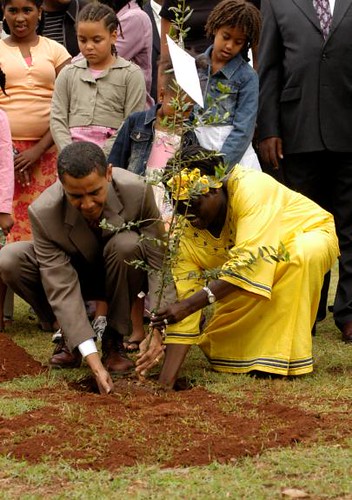
Photo Credit: Professor Wangari Maathai plants a tree with Senator Barack Obama in Nairobi by Frederick Onyango.


Thursday, October 19, 2006

Artivist Film Festival & Awards

I have said in the past that I believe art does not exist only to entertain but also to challenge one to think, to provoke, even to disturb, to engage in a constant search for the truth.--Barbra Streisand.

The 3rd Annual Artivist Film Festival & Awards' mission is to strengthen the voice of international activist artists and raise public awareness of global issues.

This year's festival is November 9-12, 2006 at the Egyptian Theater in Hollywood, California. I would love to go, but the p.units will be in town visiting me and we'll be going to the Green Festival in San Francisco that weekend.

If I was going, I'd go see:

Freedom Fuels/Sustainable Table on November 11th at 6:15 PM, tix $12.

"FREEDOM FUELS (0:40) Dir - Martin O'Brien
This documentary takes an in-depth look at biofuels from a global perspective and explores how the petroleum industry and alternative fuels have interacted over the last 150 years.

SUSTAINABLE TABLE (0:52) Dir - Mischa Hedges
Sustainable Table is a feature documentary that takes an unadulterated look into the food you eat. What's on your plate? Where does it come from? What effects does it have on the environment and your body?"
And I'd see Shape of Water/Diana's Story/Tibetan Nun's Project on November 12 at 3:45 PM, tix $12.

"DIANA'S STORY (0:06) Dir - Listen Up! Youth Network

My country was at war for 36 years and community structures and resources have been destroyed. While a gang can protect you, it's all too easy to get hurt. I know because I was raped by one of the members of our gang. My healing comes through my involvement with the Iqui Balam Theatre Troupe.

TIBETAN NUN'S PROJECT (0:05) Dir - www.channelg.tv

The Chinese communist takeover of Tibet in 1959 forced more than 100,000 Tibetans to flee into exile. Over 6,000 monasteries were demolished and religious practice was deemed illegal. The Tibetan Nun's Project supports nuns in six different nunneries, two of which we have built from the ground up.

THE SHAPE OF WATER (1:10) Dir - Kum-Kum Bhavnani

The Shape of Water, narrated by Susan Sarandon, interweaves the contradictions and joys of everyday life for Khady, Bilkusben, Oraiza, Dona Antonia, and Gila in Brazil, India, Jerusalem, and Senegal. The women spearhead rainforest preservation (rubber-tappers in Brazilian rainforest): sustain a co-operative of 700,000 rural women (world's largest trades union, India): promote an end to female genital cutting (Senegal): oppose war and the occupation of Palestine (Women In Black, Jerusalem): maintain the Navdanya farm (Himalayan foothills) to further biodiversity and women's role as seed keepers. Fresh insights are offered into the tensions between new traditions and old cultures as it portrays these unsung visionaries creating a more just world.
Send me a review if you go!

Hat tip to Elisa Camahort of Hip and Zen Pen for the story.


Tuesday, October 17, 2006

Soap and Self-Esteem

OK, ladies, who here hasn't flipped through a magazine and thought, I wish I looked like her. If I just bought a new outfit, got a haircut, lost weight, bought new makeup, exercised more, etc., I would look like her. As part of their "Campaign for Real Beauty," Dove Soap has produced a pretty amazing one-minute movie that shows the "Evolution" of an "everywoman" into a supermodel. Wow, they get a lot of help.

Dove has also created the Dove Self-Esteem Fund which funds the uniquely ME! program for Girl Scouts in the United States, the BodyTalk program in the UK, and the Beyond Compare photo exhibition in Canada and the Netherlands.

Do I know that they are doing this to sell Dove soap, yes. Am I happy that some girl's or woman's self-esteem might be positively affected while they are selling soap, sure, why not?

Hat tip to the GOOD magazine blog for the story.

Photo credit: Screenshot from the Dove site.


I've Started a New Blog: Basic Blogging for Women

Whew! I worked all day today and yesterday to create the beginnings of a new blog, Basic Blogging for Women. Sadly, the Basic Blogging for Women workshop that I was planning to teach this upcoming weekend didn't fill up so I've cancelled it, but I will be working one-on-one with some of the women who signed up. In preparing to work with them, I wanted to create an online resource that they can refer to as they work on their blogs and where I can post links to interesting posts about blogging. I won't be updating it as frequently as Have Fun * Do Good, just when interesting pieces about blogging come my way. Please pass it on to any women you know who are interested in starting to blog. I hope it is helpful to them.


Monday, October 16, 2006

Two Short Films for a Laugh

It is a dreary grey Monday morning here in the Bay Area. If you need a laugh over your coffee or lunch break today, here are links to two Internet movies that are good for a chuckle.

Ha-Hoa Dang, the Web Assistant for EMILY's List wrote me last week to let me know that EMILY's List, a political network for pro-choice Democratic women, has partnered with the September Fund, a 527 group set up by former Clinton advisor Harold M. Ickes, to post the Fund's video "Vote for Change." As you can see from the screenshot, there are some folks talking to a bush . . . I think you can see where this is going. You can watch it with Quicktime or Windows Media here, or watch it on YouTube.

Last week I went to NetSquared's monthly San Francisco Meetup and talked with Japhet Els, Rainforest Action Network's Online Organizer. He told me about their recent Internet movie, "Petrolius: The Oil Habit," a spoof oil commercial. You can watch it on RAN's site, or on YouTube.

As of this writing, 104,168 people have watched the September Fund ad on YouTube since October 12th and 13,688 people have watched "Petrolius" since September 5th. It is pretty amazing how viral videos have become an integral part of outreach for political and social change organizations.

If you are interested in tools and examples of nonprofits using vlogging and digital storytelling to do their work, check out my notes from last week's NetSquared Meetup in San Francisco.


Friday, October 13, 2006

And the Nobel Peace Prize Goes To . . .

Friday the 13th is a lucky day for the Grameen Bank and its founder, Professor Muhammad Yunus, who won the 2006 Nobel Peace Prize today.

According to the organization's web site:
The Grameen Bank provides credit to the poorest of the poor in rural Bangladesh, without any collateral. . . . As of May 2006, it has 6.61 million borrowers, 97 percent of whom are women. With 2,226 branches, GB provides services in 71,371 villages, covering more than 100 percent of the total villages in Bangladesh.
When Frances Moore Lappé and Anna Lappé wrote their book, Hope's Edge: The Next Diet for a Small Planet, they met Professor Yanus who told them about how he started the Grameen Bank. In the mid-70s, there was a famine in Bangladesh while Professor Yanus was the Head of the Rural Economics Program at the University of Chittagong. Yanus told the Lappés,
"I came to the conclusion that these theories were useless for these dying people. . . I realized that I could help people as a human being, not as an economist. So I decided to become a basic human being."
Through talking with poor people, he came to realize that most of them did not own land and that to earn money they made things. To make things, they had to borrow money to buy materials, but once they paid the lender back with interest, there wasn't enough to live on.

Yunus' first loan was from his own pocket, $27 for 42 people. When he went to a bank to ask if they would help, he was told that the bank wouldn't give loans to people who didn't have collateral, even though Yanus showed the bank evidence that the loans he was continuing to give out of his own pocket were being repaid.

So he decided to start his own bank. He told the Lappés,
"People always ask me, 'How did you get these ideas about lending to the poor?' I say: I knew I had to change the institutions themselves, and whenever I didn't know what to do I would look at the banks, and whatever they did, I did just the opposite. Every time I got into difficulty, I would just reverse the way banks do things, and that became the Grameen Bank."
You can learn more about the Grameen Bank and Muhammad Yunus watching The New Heroes, a PBS series that profiles 14 social entrepreneurs and is available on DVD, by reading Yunus' memoir, Banker to the Poor: Microlending and the Battle Against World Poverty, or watching this video by the Grameen Foundation USA on YouTube.

Photo Credit: "With Grameen borrowers preparing yarn for weaving" from the Grameen Bank web site.


Thursday, October 12, 2006

Volunteer with Shunku Llacta and Visit the Rainforests of Ecuador

In June 2005, my friend Abby Jaramillo, the Executive Director of Urban Sprouts, brought six international volunteers to two rural communities in the rainforests of Ecuador, Guayabillas and Santa Rosa, with the organization Shunku Llacta. While the volunteers were there, artisan groups in each community, the Comite Artesanal de Guayabillas and the Grupo Artesanal “La Ilusion” de Santa Rosa, hosted them, which gave both communities skills in eco-tourism. The volunteers helped to construct public bathrooms and worked in the communities' schools.

January 10-24, 2007, the artisans' communities will host eight Shunku Llacta volunteers for two weeks. The two communities are located in the rainforest of northwestern Ecuador and are so remote that they can't be reached by car. Volunteers will work with community members on projects like building a community center, working with children in local elementary schools, and practicing sustainable forest management work. They will stay with residents of each community and have opportunities to explore the rainforest with its diverse native plants, waterfalls and swimming holes.

The volunteer requirements are:

* Be at least 18.
* Fluent in English or Spanish, and at least basic knowledge of Spanish (equivalent of at least two college semesters).
* Interest in community development and cross-cultural communication.
* Other topics of interest may include sustainable agriculture or forestry, production of artisan handicrafts, eco-tourism, education, health, or rural economic development.
* Good health and willingness to stay and work in an extremely remote and rural location.
* Experience living or working with diverse communities.
* Desire to create a community action project which you will implement on your return home, involving your home community in communication and suppport with the communities in Ecuador.

The cost of the trip is $350 and does not include airfare to Quito. The cost includes all in-country travel, room, board, and program expenses during the trip. You are responsible for obtaining your own travel insurance. Two partial scholarships are available.

To apply: Send a resume and cover letter explaining why you are interested in the project, how you meet the requirements, and any related experience you have to Abby Jaramillo, Project Coordinator at shunkullacta@yahoo.com.

Photo: A volunteer helps to harvest fruit.


Wednesday, October 11, 2006

Sam Suds and the Case of PVC, The Poison Plastic

Did you know that new car smells and new shower curtain smells are from poisonous chemicals off-gassing from PVC (polyvinyl chloride) plastic? Or that children can be exposed to phthalates, poisonous chemicals that PVC releases, by chewing on vinyl toys? I sure didn't. Even more disturbing, PVC plants are disproportionately located in low-income communities and communities of color.

The nice folks at Free Range Studios whose Principal, Jonah Sachs, I interviewed for the Big Vision Podcast, wanted me to let folks know about a new 3-minute movie they've created for the Center for Health, Environment and Justice to teach people about the dangers of PVC called, Sam Suds and the Case of PVC, the Poison Plastic. Like The Meatrix and Store Wars, Free Range uses humor and fun to get their message across.

Sam Suds is a bar of soap in charge of protecting the Johnson family from dangerous toxins. His next case is to find PVC, and he's not making a lot of progress until a rubber duck he calls "Duckface" tells him,

"It's this rubber duck I've been seeing, he seemed nice enough at first, but I'm starting to suspect that he ain't made of rubber. . . I think he's PVC." She shows him a B&W photo of the duck and a boy.
"Yeah, it's little Timmy Johnson chewing on your boyfriend's head. So, what of it?" Sam asks.
"Look closer," she says.
"Hey, what gives? There's a three on this duck's butt." Sam says.

As Sam searches for his suspect, he finds out from a shampoo bottle that the three with arrows is the mark of PVC. When he finally finds the PVC duck and threatens to flush him down the toliet the duck tells him, "What good will it do you? This bathroom is full of PVC."

For more information about PVC, and to watch Sam Suds, go to www.pvcfree.org. They are also asking folks to sign an online petition to ask Target to phase out PVC in products and packaging. Apparently, Wal-Mart has committed to phasing out private label PVC packaging in two years and other companies like Nike, Microsoft, Ikea, H&M, and Johnson & Johnson are phasing out PVC as well.


Tuesday, October 10, 2006

Have Disrespect * Do Bad : Angry Commenters on This Blog

Anyone can become angry. That is easy. But to be angry with the right person, to the right degree, at the right time, for the right purpose and in the right way - that is not easy.
--Aristotle

Yesterday I had my first angry commenters on what seemed like an innocuous post about women speaking at the Green Festival:

Will Joan Blades also tell her audience how Jews control the media, Jews manipulate U.S. foreign policy, the Jews and/or Bush blew up the World Trade Center on 9/11, and African-American soldiers are all potential mutineers who should be segregated and disarmed?

Every single one of the above positions were stated at MoveOn's Action Forum, and they received overwhelming approval from the other participants.

More at today's Washington Times
http://washingtontimes.com/op-ed/20061008-101402-3621r.htm


And:

Eli Pariser of MoveOn.Org told Mr. Foxman of the ADL that the MoveOn.Org forum was open to anyone and that they didn't control the posts. This is a lie.

Back in April, 2004, I complained on the Forum and in letters to MoveOn.Org that they were allowing anti-Semitism. (Note: saying Jews control the media is not anti-Israel, it is anti-Semitic.)

So, what happened? My posts were erased and I was banished. The anti-Semitic posts and posters were allowed to stay.

So, if you like anti-Semitism, support MoveOn.Org and accept support from MoveOn.org.


I was humored and saddened. Humored because it's not like this blog is Talking Points Memo and the idea that someone took the time to vent their anger here seemed like misplaced advertising--like trying to sell bikinis in Antarctica. Last week I wrote about Blogging for Chickens and Halloween candy. We're just not that hard core here.

What saddened me was the tone. It would be pretty exciting to have more discussion on Have Fun * Do Good, but only if it is written in a respectful tone. I've created Have Fun * Do Good to be a respite from the negative news we hear most of the time. If readers want to challenge some of the stories here and reveal the dark side of do * good ventures, I welcome it whole-heartedly, those stories are important to hear, but please do so with respect.

Every argument has two sides. To get the other side of this one, I emailed my friend Ilyse Hogue, who is the Campaign Director for MoveOn.org. Here was her response:

MoveOn's ActionForum is an open forum. Anyone can post comments and many of the comments identified were not, in fact, made by MoveOn members.

MoveOn removed the comments as soon as they come to our attention.

The Anti-Defamation League (ADL) welcomed the responsiveness of MoveOn. ADL believes the matter has been resolved satisfactorily [link is mine].

Anti-Semitism is a serious charge. Six out of the eight members of MoveOn's executive team are Jewish, and we are personally very aware of the ongoing reality of anti-Semitism. We also know that fabricating charges of anti-Semitism as a political smear does real damage to the cause of tolerance, because it undermines the credibility of those who identify anti-semitism where it does occur, and reduces our collective ability to combat it.
Whew. I'm tired now. I'm going to go back to looking for some have fun * do good stories for y'all for tomorrow and leave you with this quote:
Respect for ourselves guides our morals; respect for others guides our manners.
--Lawrence Sterne
Photo credit: Sad Puppy by Geoff Stearns.


Monday, October 09, 2006

Powerhouse of Solutionary Women Speaking at the Green Festival

I've been to the Green Festival in San Francisco for the past four years and each year I look forward to it. It's affordable, the tickets are $15, and it's super fun. I took my parents last year and they are coming out again this year to go again.

The Green Festival is October 14-15 in Washington DC, November 10-12 in San Francisco, and April 21-22, 2007 in Chicago.

There are tons of amazing speakers at all of the events, including some fabulous visionary, activist and social entrepreneurial women.

Check out some of the women speaking at the Green Festival in San Francisco:

* Alice Walker will be speaking about "We Are the Ones We Have Been Waiting For."
* Alisa Gravitz, Co-op America's Executive Director, will be talking about "Solar Future: Making It Happen Now."
* My friend, Alli Chagi-Starr, will be talking about arts activism and her organization Art in Action.
* Amy Goodman from Democracy Now! will speak about "Independent Media in a Time of War."
* Joan Blades, co-founder of MoveOn.org, will speak about,"Motherhood: The Next Political Movement."
* Lisa Day of Participant Productions is on a panel entitled, "Changing Minds Through Media."
* Medea Benjamin, Founding Director of Global Exchange will talk about Code Pink, which she co-founded.

If you live on the West Coast, East Coast or in the Midwest, it's worth the trip to check out your local Green Festival.


Friday, October 06, 2006

Fight Hunger Viral Video Contest

In 2006, 760,000 people in 118 countries and 420 locations walked as part of the Walk the World campaign. Now FightHunger.org (a project of the UN World Food Program and partners) is launching a Walk the World Viral Video Contest. They are looking for an, "upbeat viral video that spreads the word about ending child hunger by 2015."

Here's how to enter:

"Create your video (no longer than 120 seconds) and submit it to your favourite online video service (such as YouTube.com or Google Videos). Read the contest rules before you submit your entry. The closing date for entries is 15 Dec 2006. Winners will be listed on this site on 29th Dec 2006.

To enter the contest first register and login to the site. Then submit your entry using this webform. If your video is accepted we will send you a confirmation email."

The WFP has a lot of groovy stuff going on on their site:

A blog (except, I can't seem to find its feed to add it to my Bloglines account), a news aggregator (although I'm not sure why this article about The World's Wackiest Hotels is in it), the online game, Foodforce where winning means feeding millions of hungry people in "Sheylan," and a YouTube channel.


Thursday, October 05, 2006

Blogging for Chickens: Using Your Blog to Raise Money for a Good Cause

Darren Rowse celebrated ProBlogger's second birthday by raising $1100 (AU), or about $830 US, to buy 110 pairs of chickens for impoverished families via Oxfam Australia. He put a percentage of his weekly blogging income into buying chickens and invited his readers to contribute as well.

Readers could give in one of two ways: donate to Oxfam Australia directly, and send Darren an e-card during the purchasing process to let him know how many chickens they had purchased, or send him a donation via PayPal with a note saying that it was for the "chickens project."

He put up a "chook-o-meter" in the sidebar which tallied the number of chickens that had been donated (pictured here). When Oxfam contacted Rowse, they said that Blogging for Chickens was, "one of the more interesting fundraisers that they’ve seen."


Wednesday, October 04, 2006

Have Fun * Do Good Halloween Chocolate

According to Professional Candy Buyer Magazine, here are the Top 5 Halloween Chocolate Vendors, and what I think are their sales for 4 weeks ending November 6, 2005:

THE HERSHEY CO. $246,451,200
MASTERFOODS USA $157,794,100
NESTLE USA INC $60,222,940
RUSSELL STOVER CANDIES INC. $10,317,960
LINDT & SPRUNGLI USA $4,619,996

As I mentioned in my "Pink M&Ms and Fair Trade" post, Global Exchange reported that:

In 2001, the U.S. State Department, the International Labor Organization and others reported child slavery on many cocoa farms in the Ivory Coast, source of 43% of the world's cocoa. Subsequent research by the International Institute of Tropical Agriculture revealed some 284,000 children between the ages of 9 and 12 working in hazardous conditions on West African cocoa farms. Of these children, it was reported that some 12,000 child cocoa workers that had participated in the study were likely to have arrived in their situation as a result of child trafficking.
Improvements have been made, but not to the extent they need to be, so if you're giving out Halloween candy this year, considering giving out Fair Trade Chocolate from Art Bars, Dagoba, Equal Exchange and Divine, or order Global Exchange's Trick or Treat Chocolates ($7.95 for 42 pieces).

I ordered some last year, but no trick o' treaters came to our door so I err, ate them myself . . . I think I went a little over my 8 teaspoons of sugar that day . . .

Update 9/28/10:  Here's a more recent post about Fair Trade chocolate, Nine Fair Trade Chocolate Bars.


Tuesday, October 03, 2006

Make Cupcakes, Not War

I know yesterday I was bemoaning the amount of sugar Americans eat, but I do LOVE cupcakes, and Marnie Webb sent me the link to this cute blog that I had to share.

5 year old Isabella Lamb is running for the presidential election in 2040. Ok, really, her parents have set up the campaign as a statement for campaign finance reform. As her father, Paul Lamb, says in his August interview on NPR's Marketplace:

"I nearly cried when I heard presidential candidates spent $880 million during the 2004 election. That's about $3 for every man, woman and child in the United States.

Not only is it a ridiculous waste of money, but it means that only the super-rich or super-connected can even begin to contemplate a run for the presidency.

Well, I for one am not waiting around for real campaign finance reform any longer. I have decided to take matters into my own hands and those of my daughter's.

I am taking my $3 and investing it in a presidential campaign to elect my oldest daughter, currently age 5, to the presidency in the year 2040."
Her campaign platform is based on what she learned in kindergarten:
1. Play nice
2. Don't cheat
3. Help out without being asked
4. Raise your hand before you talk
5. Share with everybody
6. Don't lie
7. No yelling
8. No fighting
9. Pick up after yourself
10. Don't take things that aren't yours.
And she has a slogan: "Make Cupcakes Not War."

You can order t-shirts, coffee mugs or bumper stickers here.


Monday, October 02, 2006

Nutrition and Education Go Hand in Hand

Abby Jaramillo, the Executive Director of the school gardening nonprofit, Urban Sprouts, recently posted about an experiment she did with some of her students from June Jordan, a San Francisco public middle school. Each student kept a 24-hour food diary and wrote down the nutrition facts for all the foods they ate. At the end of the week they totaled the percentage of calories from fat, the total grams of sugar eaten in one day, and how much dietary fiber they were eating.

"One Jamba Juice finished a student for the whole day, and another student needed to double bag his sugar collection," Abby writes.

According to NutritionData, a 16 oz Coldbuster Jamba Juice has 70 grams of sugar, a 12 oz Starbucks Caffe Vanilla Frappuccino, a popular drink with Abby's students, has 42 grams of sugar, and a 12 oz Child Size McDonald's Beverage Coca Cola Classic has 30 grams of sugar. The 2005 Dietary Guidelines for Americans states that a 2,000-calorie diet allows for 267 "discretionary calories" or 8 teaspoons (32 g) of sugars.

One woman working for better nutrition for young people is Chef Ann Cooper, author of Lunch Lessons: Changing The Way We Feed Our Children. Check out her list of Tips for Healthy Eating with your kids on her blog. You can see a video of Chef Ann on the site of two other food activists, Amy Kalafa and Susan Rubin, who are making a movie about school cafeteria food called, Two Angry Moms.